Top 12 Financial Forecasting Software: Features + Real Reviews [2026]
Oleksandr Riabukha
Head of R&D at Fuelfinance
January 9, 2026
The last few years taught us all that economic uncertainty is probably the only constant you can expect. Interest rate fluctuations, supply chain disruptions, regulatory changes — any of these can derail even the most promising business. Yet some companies not only survive but thrive.
How? We always plan for the worst possible scenario. Our best tip is to make your baseline plan 5-10% worse than last month's average. That way, you're always prepared when things go south — and pleasantly surprised when they don't.
With the right financial forecasting software, you can navigate uncertainty with confidence. We've analyzed the top 12 reporting tools that help keep you profitable and growing, no matter what life throws at you.
Best financial forecasting software & tools: comparison table
Tool name
Best for
Key forecasting features
G2 rating
Fuelfinance
SMBs, agencies and growing companies needing AI forecasting plus fractional CFO support
AI-driven financial modeling with confidence scores
Scenario planning and plan vs. actuals
Automated financial reports
Natural-language dashboard creation
Real-time anomaly detection
4.9
Anaplan
Large enterprises with complex, cross-department planning needs
Driver-based forecasting
What-if scenario modeling
AI-powered predictive analytics
Real-time collaborative planning
Enterprise-grade data linking
4.6
Jirav
Accounting firms and CFO advisory practices
Driver-based forecasts
Budget vs. actuals
Rolling forecasts
Three-way financial statements
Customizable assumptions and scenarios
4.7
Cube
Finance teams heavily reliant on Excel or Google Sheets
Spreadsheet-native forecasting
Scenario planning
AI-powered variance analysis
Centralized KPIs
Real-time plan vs. actuals
4.5
Vena
Mid-sized to enterprise teams standardized on Excel
Rolling forecasts
What-if modeling
Driver-based budgeting
Automated financial statements
AI Copilot for FP&A insights
4.5
Datarails
Mid-market and enterprise Excel-centric FP&A teams
Automated data consolidation
Variance analysis
AI-powered insights
Budgeting workflows
Three-statement forecasting
4.6
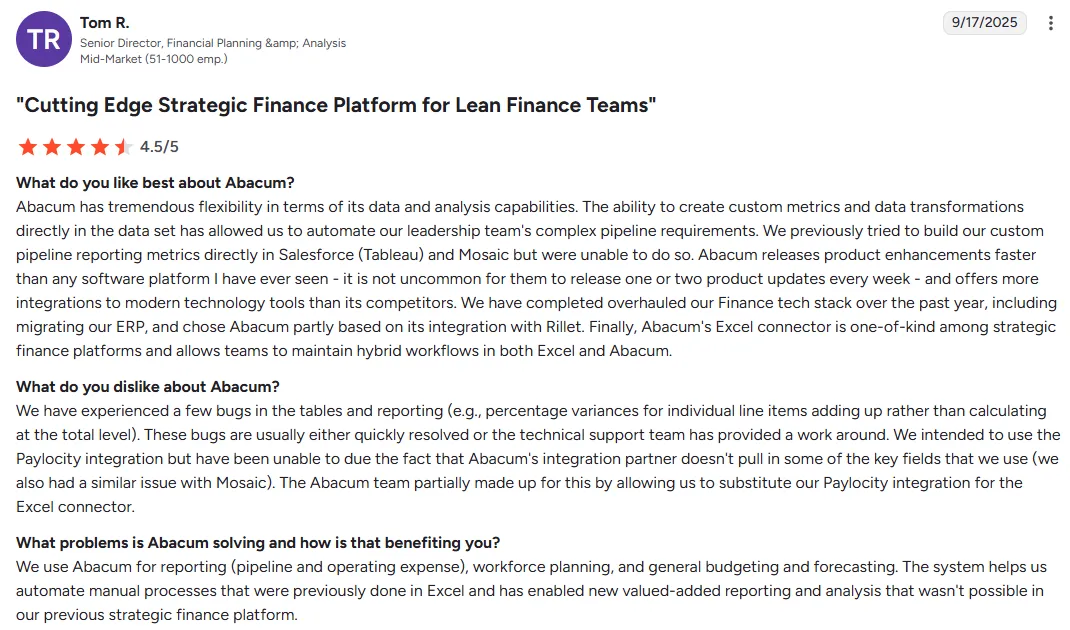
Abacum
Mid-market and growing companies modernizing FP&A
AI-native forecasting
Multi-dimensional scenario modeling
Automated reports
Real-time dashboards
Plan vs. actual analysis
4.8
Planful
Mid-market companies needing end-to-end FP&A and consolidation
Continuous planning
Scenario toggling
AI-assisted variance commentary
Budgeting and forecasting automation
Multi-entity consolidation
4.3
Mosaic
SaaS startups and growing SaaS companies
SaaS KPI forecasting (ARR, MRR, CAC, LTV)
Three-statement planning
Scenario modeling
Real-time dashboards
Headcount forecasting
4.7
Fathom
Accounting firms, franchises, and SMBs focused on reporting
Three-way cash flow forecasting
Scenario modeling
KPI benchmarking
Multi-entity consolidation
Presentation-ready reports
4.6
Scaleup Finance
Startups and scaleups preparing for fundraising
AI-assisted forecasting with CFO oversight
Cash runway planning
Scenario analysis
Investor-ready financial projections
N/A
Sturppy
Early-stage startups and non-finance founders
Guided financial modeling
Multi-scenario forecasting
AI CFO (Plus tier)
Hiring and cash flow projections
Investor-ready models
2.8
12 Best financial forecasting software & tools
Fuelfinance
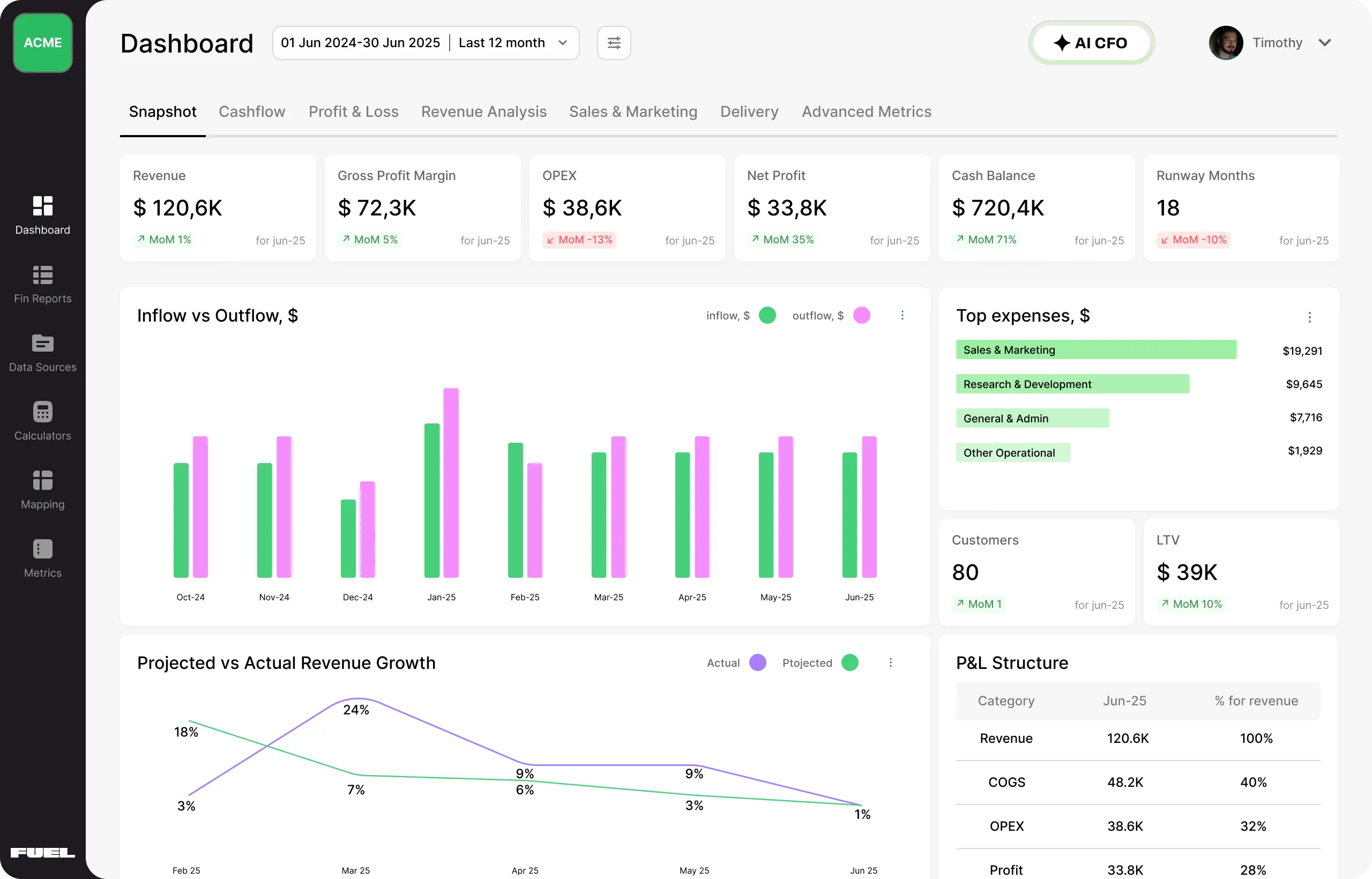
Fuelfinance is a next-generation financial management solution that combines AI-powered technology with human expertise to deliver comprehensive corporate performance management. We give you actionable insights that drive strategic decision-making across multiple departments. And you don't need to be a finance or tech expert to use the tool.
Features
AI CFO that actually understands context: Unlike basic chatbots, our AI analyzes your historical data, industry benchmarks and business model to give you useful and proactive financial insights. It builds forecasts using AI financial modeling tools, detects anomalies in real-time and assigns confidence scores so you know which predictions to trust when making informed decisions. You also get proactive notifications about any irregularities or worrying metrics before they snowball into business risks.
Natural language dashboard creation: Tell the AI "show me marketing spend efficiency by channel" and watch it build the exact dashboard you need — no coding, no waiting for IT. This alone saves significant time analyzing data compared to the manual dashboard creation process in other financial performance tools. It's like having ChatGPT for finance built directly into your financial dashboard software.
Automated financial reports: Your P&L, balance sheet, cash flow management statements and custom KPI reports update automatically as financial data flows in from your connected data sources through automated data consolidation. No more spending days on the month-end close or dealing with manual input — we handle everything for you.
350+ integrations: Connect with virtually every tool finance teams use — QuickBooks, Stripe, HubSpot, payroll systems, banks, CRMs and more. Fuelfinance gives you comprehensive data consolidation from day one, creating a unified view across all your financial processes and helping you gain valuable insights across sales data, human resources information and entire organization metrics.
Financial planning & forecasting: Build sophisticated financial models in minutes. The AI suggests relevant drivers, flags unrealistic assumptions and helps you model different strategies for scenario analysis. Plan future budgets with both conservative and optimistic scenarios, enabling you to prepare for all possible circumstances. The forecasting process updates with weekly or monthly data based on your needs, including support for zero-based budgeting approaches.
Plan/actual analysis tools: Compare your planned financial figures to actual results with high-precision forecasting that shows how your finances are performing. The system identifies gaps and enables quick adjustments across cost centers and project management initiatives.
Dedicated finance manager: Every client gets assigned a finance professional who knows your business. They handle setup, answer questions, provide strategic guidance and function as your fractional CFO. Department managers get the expert support they need to understand financial plans and make data-driven decisions.
Web-based dashboards plus Google Sheets: Access your financials through intuitive web dashboards or work in familiar Google Sheets. The flexibility means your whole team can engage with financial data, not just the Excel experts.
Key advantages
Modern cloud architecture built from the ground up for faster performance
Fractional CFO support from actual finance professionals who review your numbers
Rapid setup — get operational in two weeks with expert help
Real-time accuracy with AI confidence ratings for each prediction
Comprehensive corporate performance management with all key features tailored to your business model
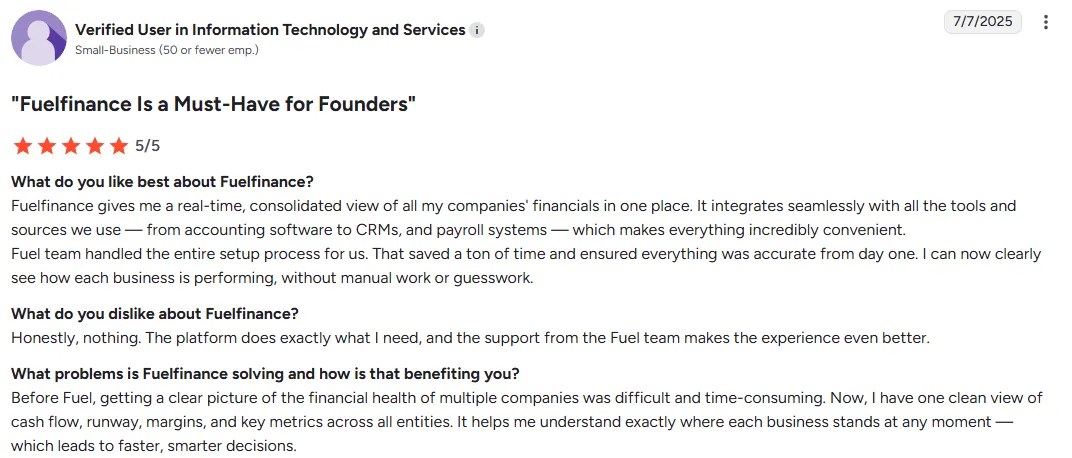
Customer feedback
Image source: G2
Here are customer success stories showcasing what you can achieve:
Petcube: Created accurate forecasts with only 2-5% deviation from planned results — a 5x better solution, 10x cheaper than an in-house financial department
O0 Design: Automated data consolidation with 80% of transactions automatically categorized. Built accurate revenue forecasts connected with hiring and expense planning, cutting time spent on financial management by half and doubling YoY growth
Hampton: Stored all financially relevant data in one place, reduced financial risks, and created easily readable management reporting built for their business needs, cutting report preparation time by up to 24 hours
Testimonial Hero: Gained real-time visibility into key metrics, reduced financial admin work significantly, and cut finance costs by 50% while getting 2-3x more value
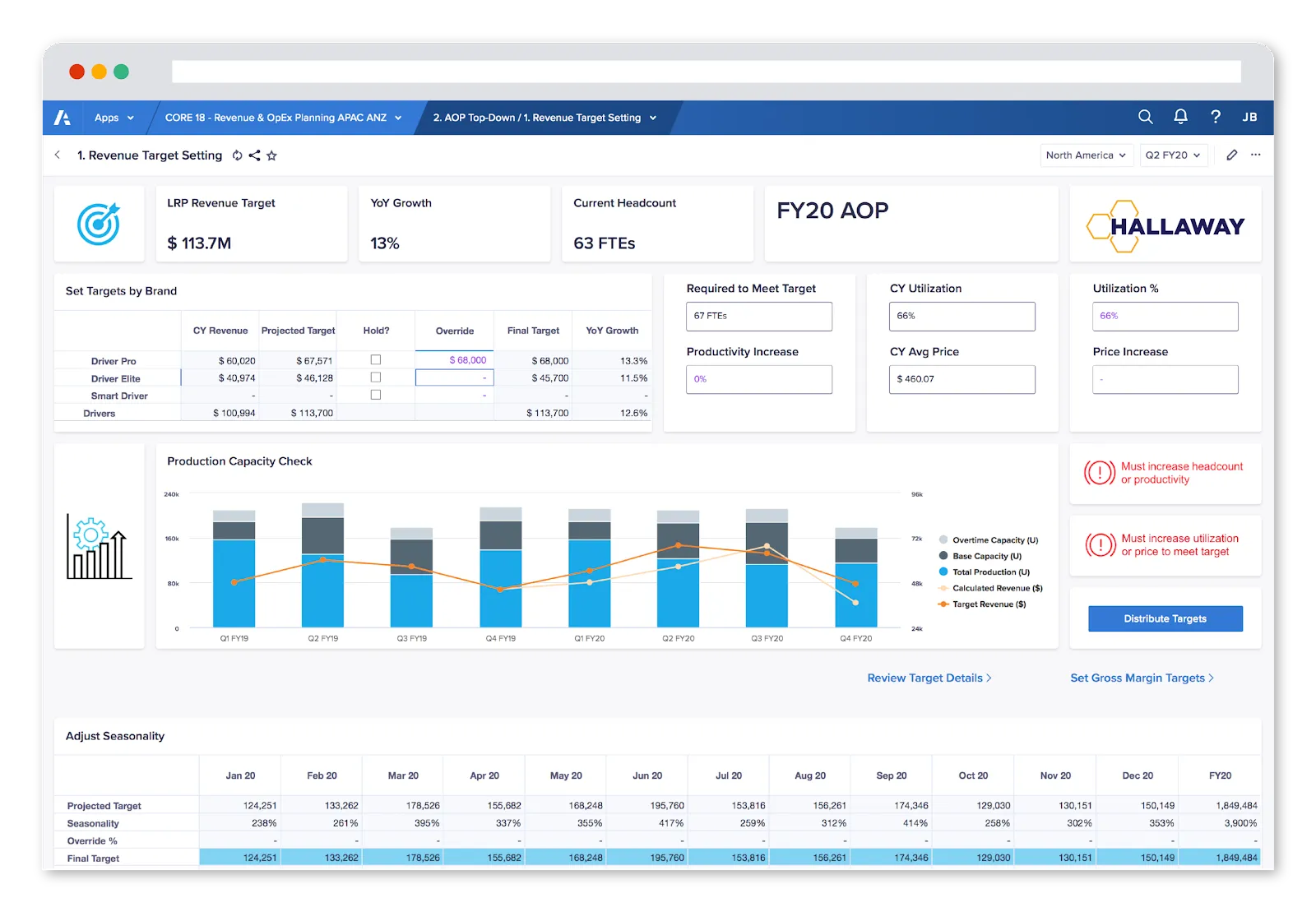
Anaplan is an enterprise-grade platform for managing corporate performance across finance, sales, supply chain, workforce and marketing. It provides real-time data for contextualizing financial performance and predicting outcomes across multiple departments. The tools streamline budgeting, forecasting, modeling, pricing optimization and other financial management tasks for large organizations.
HyperBlock®: In-memory calculation engine providing access to centralized databases for efficient cross-departmental collaborative planning and management reporting
AI-powered platform: Includes Anaplan Intelligence with machine learning that collects real-time information to give you actionable external data and supports automated data consolidation
Modeling capabilities: Continuously self-optimizing algorithms deliver customizable, predictive modeling with aggressive, conservative and "what-if" scenario planning for future revenue projections
Flexible, driver-based forecasts: Models can include nuances of goods, services, subscriptions, licenses, with unlimited dimension hierarchies supporting complex financial plans
Data linking: Connect finance, sales and operations information across the entire organization to create comprehensive financial models
Integrations: Dell Boomi, DocuSign, HyperConnect, MuleSoft, Informatica Cloud, Power BI Desktop, Tableau, Salesforce, SnapLogic, Workiva, Google Cloud Storage and API options
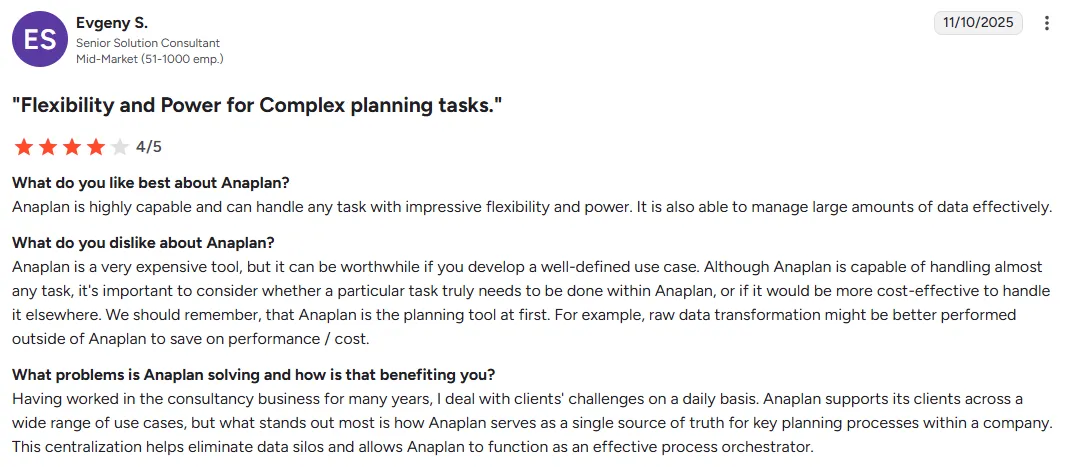
Users praise Anaplan's flexibility and real-time collaborative planning but note the steep learning curve and significant investment required. Finance leaders at larger enterprises appreciate the comprehensive corporate performance management capabilities, though implementation typically requires 3-6 months.
Jirav
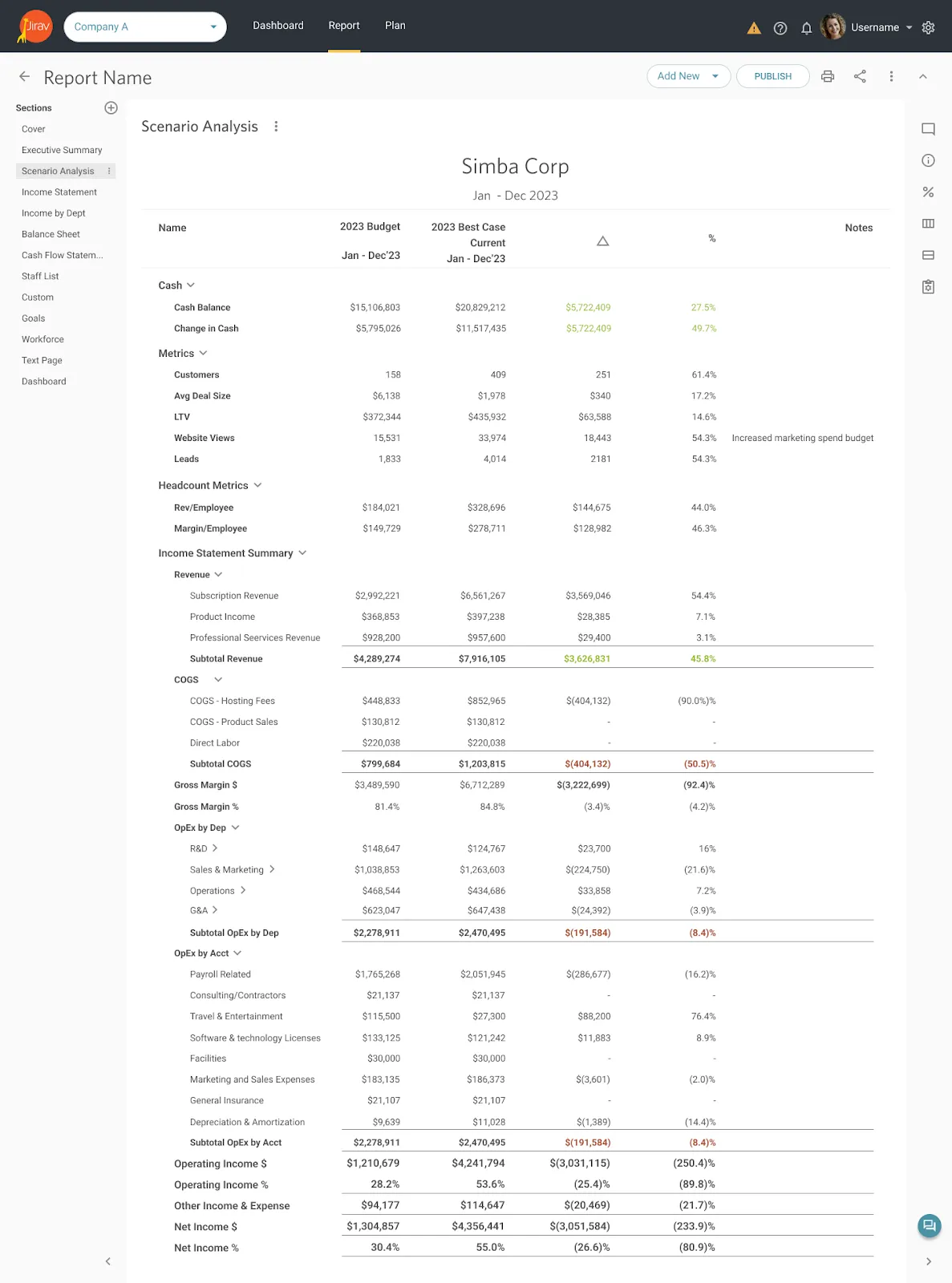
Jirav is a cloud-based financial planning and analysis solution designed specifically for accounting tools and financial budgeting needs. Built for accounting firms and their clients, it works seamlessly outside of spreadsheets while maintaining an intuitive interface. This budget planning solution is fully customizable, letting you track, predict and share data relevant to your company's specific needs.
Image source: G2
Features
Budget vs. actuals: Easily visible in dashboard views with rolling forecasts and downstream effects across multiple departments
Custom data modeling: Model the effect of purchases related to headcount, production units, supply chain costs, then clone and compare scenarios
Three-way financial statements: Income, balance and cash flow statements with forecasts for 1, 6, 12 or 60 months into the future
Custom drivers: Create your own formulas and assumptions, link cause and effect and add metrics unique to your business model
Financial data dashboards: Clear, visual data with drag-and-drop, shareable dashboards combining historical sales data and projections
Success Safari implementation: Expert-guided, fast-tracked implementation with tailored assistance from dedicated FP&A experts
Partner success manager: Available for ongoing support
Integrations: Google Sheets, Microsoft Excel, QuickBooks, ADP, Paychex, Salesforce, HubSpot, Xero, Oracle NetSuite, Google Analytics, Jira and more
Customer feedback
Image source: G2
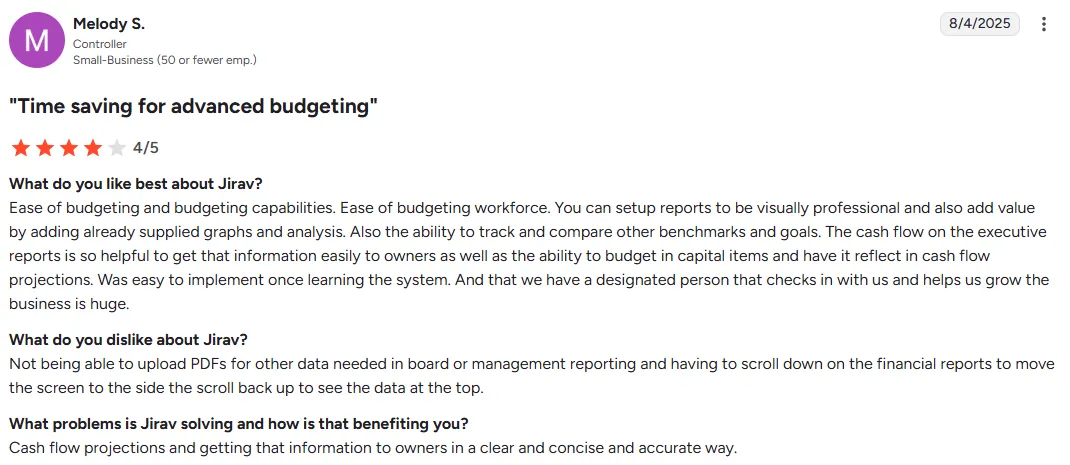
Users appreciate Jirav's driver-based planning, industry-specific templates and excellent customer support. Some note a learning curve and UX/UI areas needing improvement, though Jirav has rolled out regular updates addressing these concerns. The platform is particularly popular with accounting firms providing CFO advisory services.
Cube
Cube is an intuitive FP&A tool that facilitates financial planning without changing your existing systems. It eliminates manual work and provides real-time insights necessary for fast, agile strategizing across cost centers. As a spreadsheet-native platform, it meets finance teams where they already work.
Automated audit trail: Automates gathering, reconciling and cleaning data from multiple sources with comprehensive automated data consolidation
Customizable dashboards and reports: Build and share financial models from reusable templates for flexible reporting capabilities across human resources, sales data and the entire organization
Scenario planning and analysis: Includes workforce planning and analyzing how strategic changes impact your business in long-term views, supporting zero-based budgeting approaches
Centralized formulas and KPIs: Data stored in a single place for easier management, reporting and tracking key features across multiple departments
AI-powered features: Machine learning dynamically adapts to your needs to let you ask natural language queries and accelerate FP&A, including AI-powered forecasting, variance analysis, natural language queries and purpose-built agents for data integrity, forecasting, variance analysis etc.
Spreadsheet integration: Native Excel and Google Sheets integration — works directly within familiar tools
Integrations: Google Sheets, Microsoft Excel, Sage, Xero, QuickBooks, HubSpot, Salesforce, Google BigQuery, BambooHR, Zuora, NetSuite and more
Customer feedback
Image source: G2
Finance leaders praise Cube's spreadsheet-native approach, ease of implementation and strong customer support. Users report significant time savings from automated processes. Some note limitations in headcount planning features and dashboard customization compared to specialized tools, but overall satisfaction remains high for small to mid-sized companies.
Vena
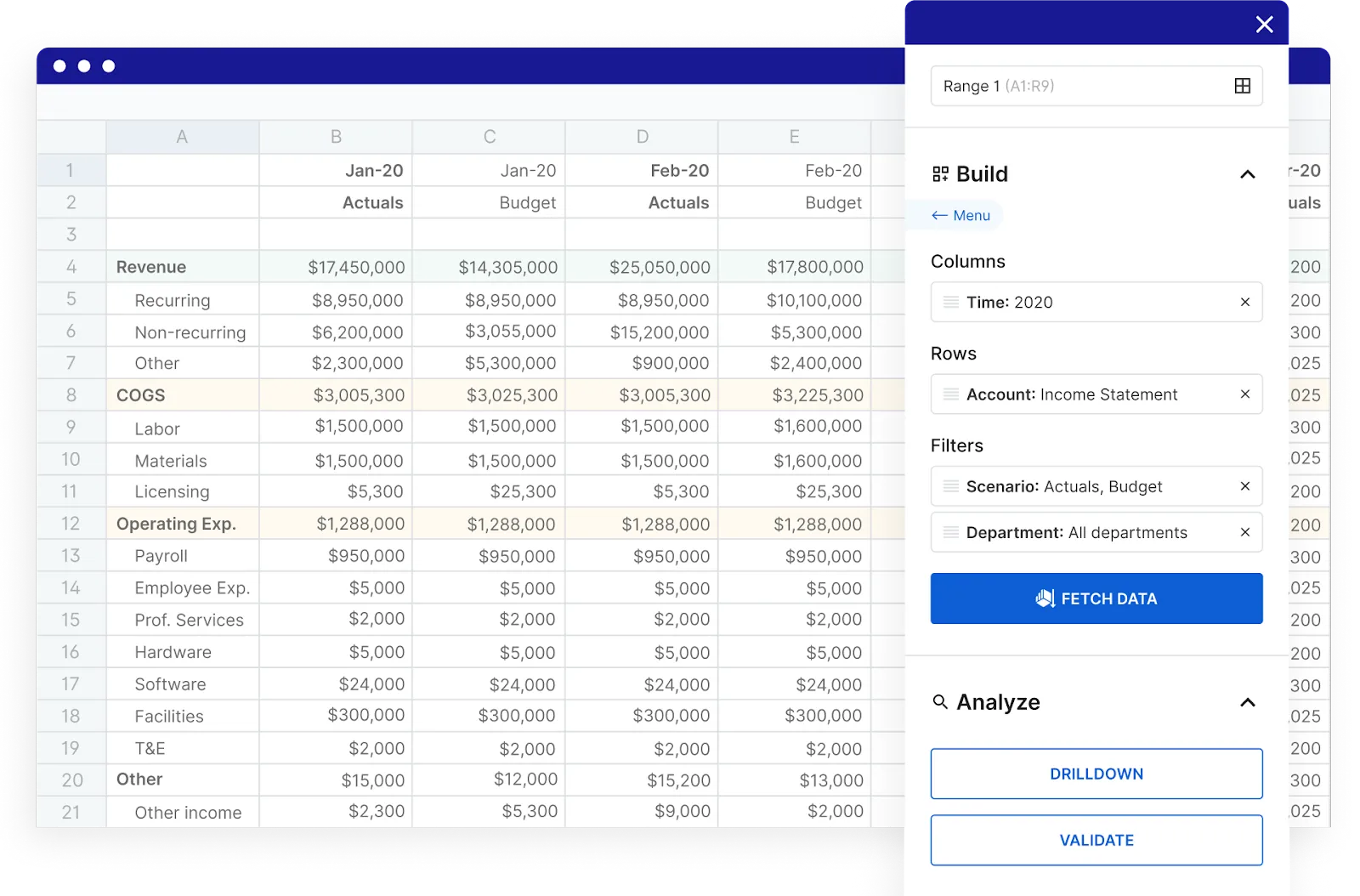
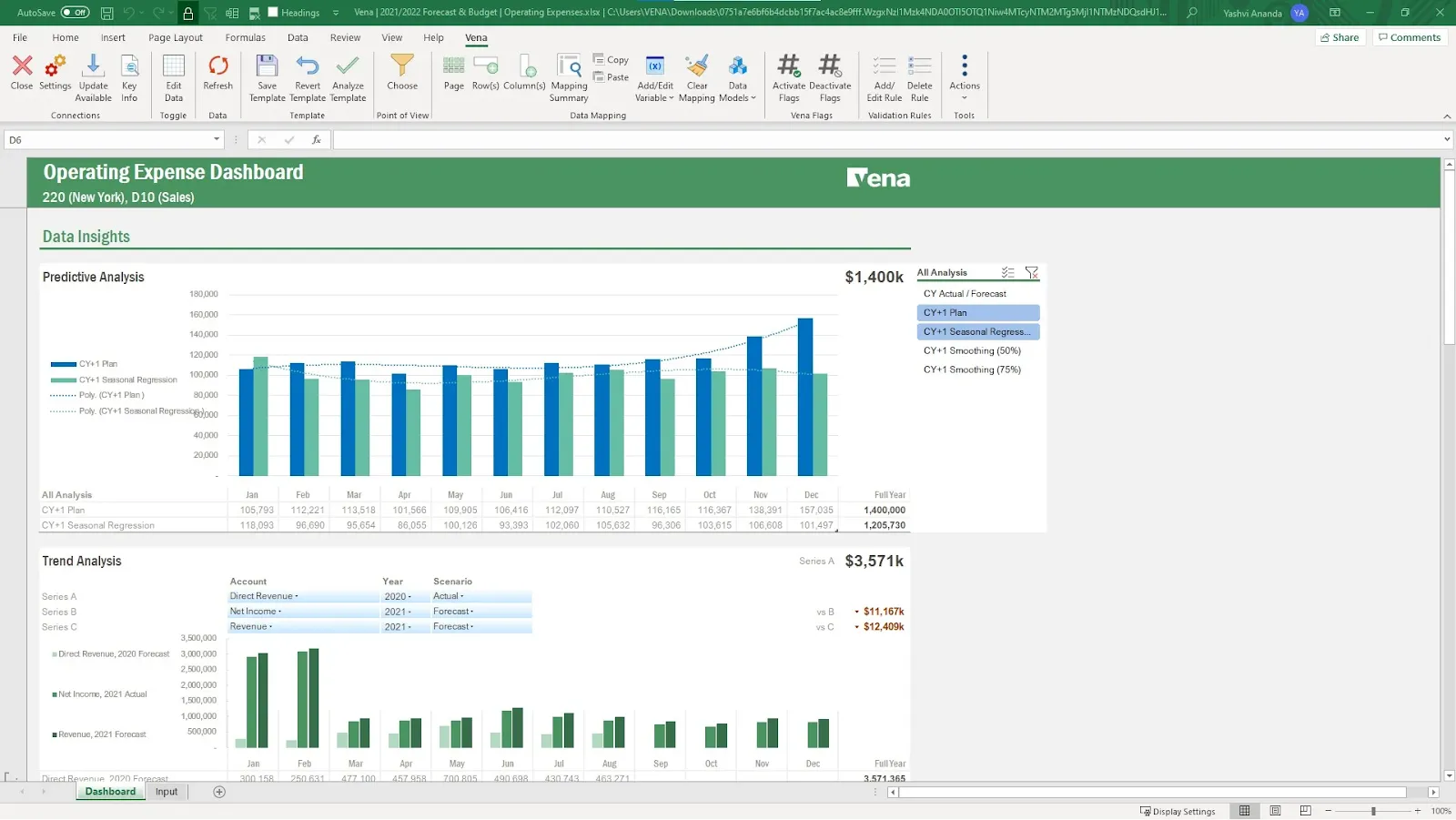
Vena is a complete planning platform with pre-built solutions that help automate time-consuming tasks related to planning your financial processes. It focuses on structured, template-driven FP&A standardization in an Excel-type interface powered with additional functionalities and automations, making it ideal for finance teams heavily invested in Excel workflows.
Financial planning: Rolling forecasts, what-if scenarios, complex modeling capabilities for planning future budgets across cost centers
Financial analysis: Compare department performance, create ad-hoc reports with natural language prompts and gain strategic insights for corporate performance management
Budgeting: Plan budgets using top-down, bottom-up, zero-based budgeting or driver-based requirements across multiple departments
Financial close: Handles end-of-month processes including automated data consolidation, account reconciliations and tax provisioning
Pre-configured FP&A solutions: Customizable system templates or prescriptive solutions requiring minimal changes
Financial statements: Automated P&L, balance sheet and cash flow generation for management reporting
Dashboards: Operating expense views, predictive analysis, trend analysis, headcount and payroll tracking — all in the familiar Excel interface
Vena Copilot: AI-powered assistant providing FP&A insights through natural language queries (also in Teams meetings), which you can use to run driver-based planning
Integrations: NetSuite, Sage Intacct, Salesforce, Intuit QuickBooks, Microsoft Dynamics 365 Business Central, Dropbox, OneDrive, SFTP, SharePoint
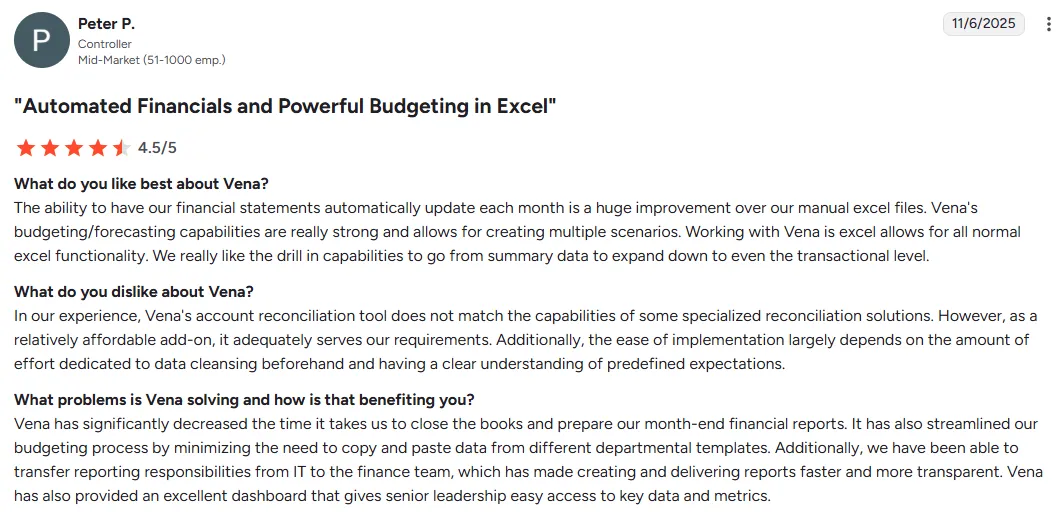
Users appreciate Vena's Excel familiarity and powerful automation for financial planning. The platform significantly reduces manual tasks and improves collaboration between finance leaders and department managers. Some users note occasional integration issues, higher pricing compared to alternatives, and a learning curve during implementation. Best suited for mid-sized to enterprise organizations with complex financial processes requiring extensive corporate performance management.
Datarails
Datarails is an Excel-native FP&A platform designed for organizing and analyzing your Excel data with enhanced visualization and clarity. This revenue forecasting software enables finance professionals to collect, report and analyze information without abandoning their existing workflows. It serves as a unified database for financial, organizational and forecasting data across the entire organization.
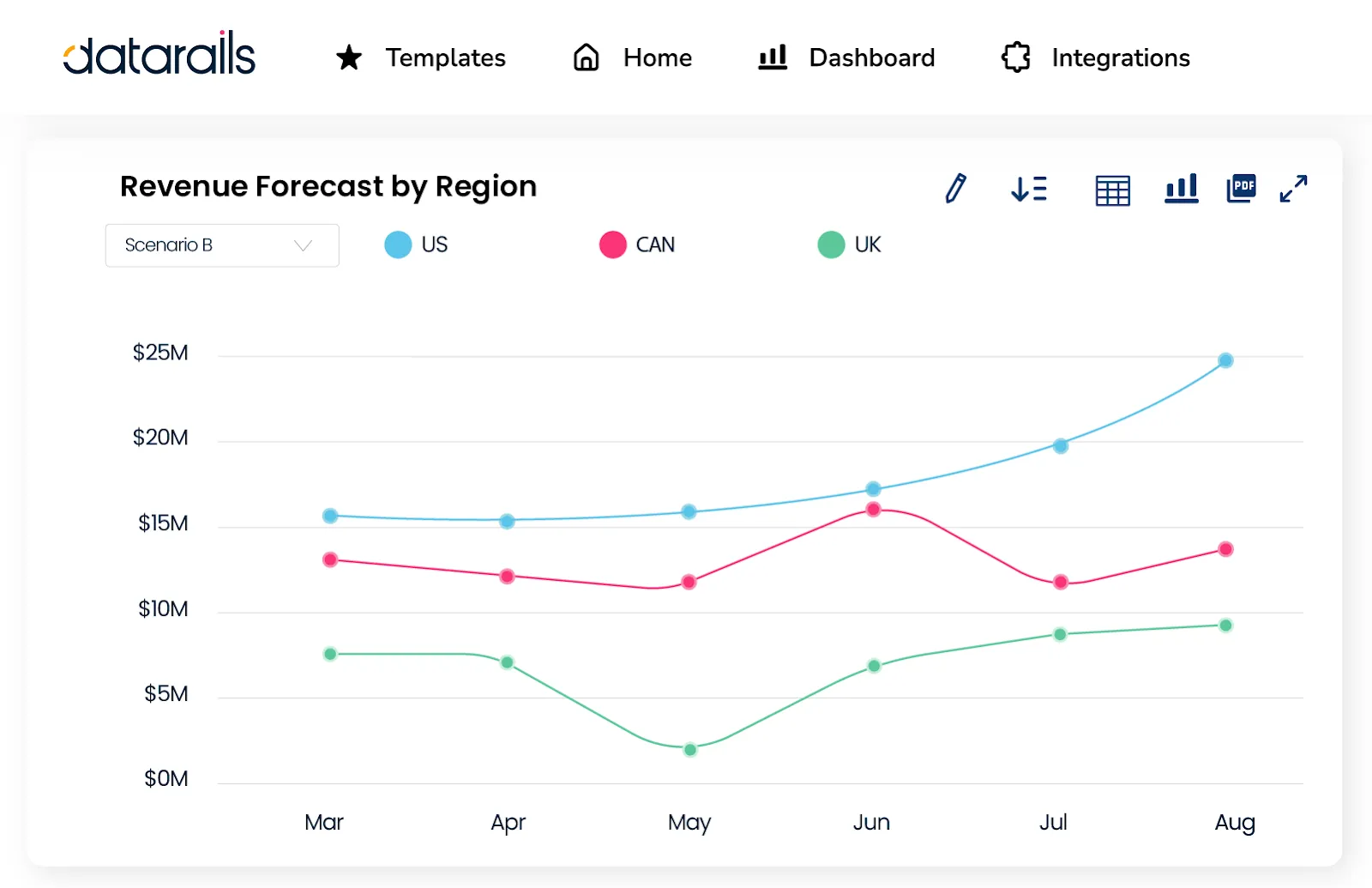
Data visualization: Easily readable graphs and charts summarizing financial metrics (YTD revenue, monthly revenue, revenue by region, sales data)
Automated data consolidation: Pulls data from multiple sources, including ERP systems, creating a single source of truth for management reporting
Budgeting: Estimate costs and future revenue with collection management, approvals, deadlines, and budget completion tracking across multiple departments
Financial reporting: Automated P&L, balance sheet, and cash flow statements that are readable and shareable across the forecasting process
Variance analysis: Examine key variance drivers, headcount, sales performance, and COGS, comparing actual data to financial plans
AI-powered insights: Datarails Genius provides conversational AI for answering finance questions and executing requests
Collaborative workflows: Real-time collaboration with version control and audit trails supporting accounting tools integration
Integrations: Microsoft Excel, Salesforce, Oracle Cloud ERP, Xero, QuickBooks, Sage Intacct, banking systems and 200+ data sources
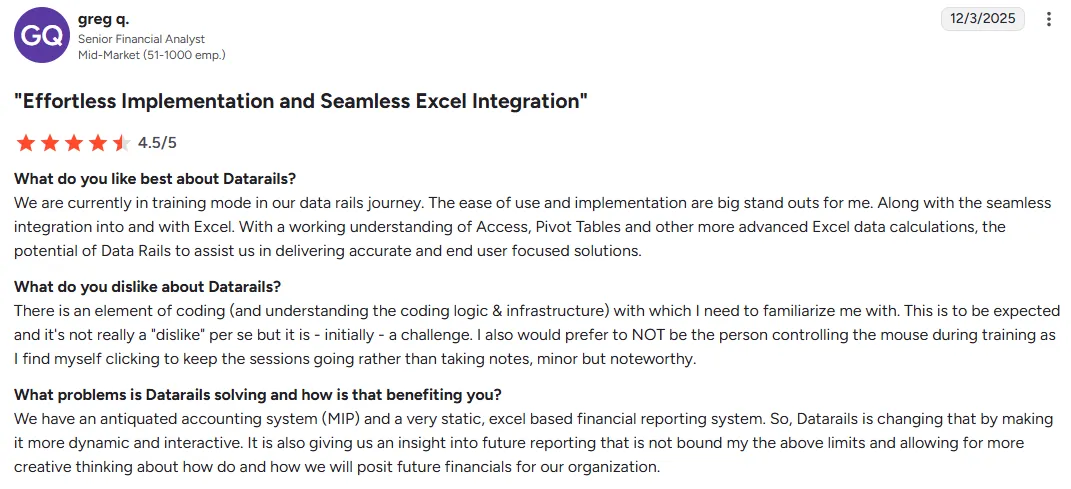
Users highlight Datarails' ability to consolidate data from multiple sources, good customer support with dedicated Customer Success Managers, and the Excel-native experience. The platform particularly excels at automated financial reporting and reducing manual processes. Some users note a steep learning curve for advanced features, occasional performance issues with large datasets, and that the platform is more suitable for mid-market to enterprise companies rather than small businesses due to pricing and complexity.
Abacum
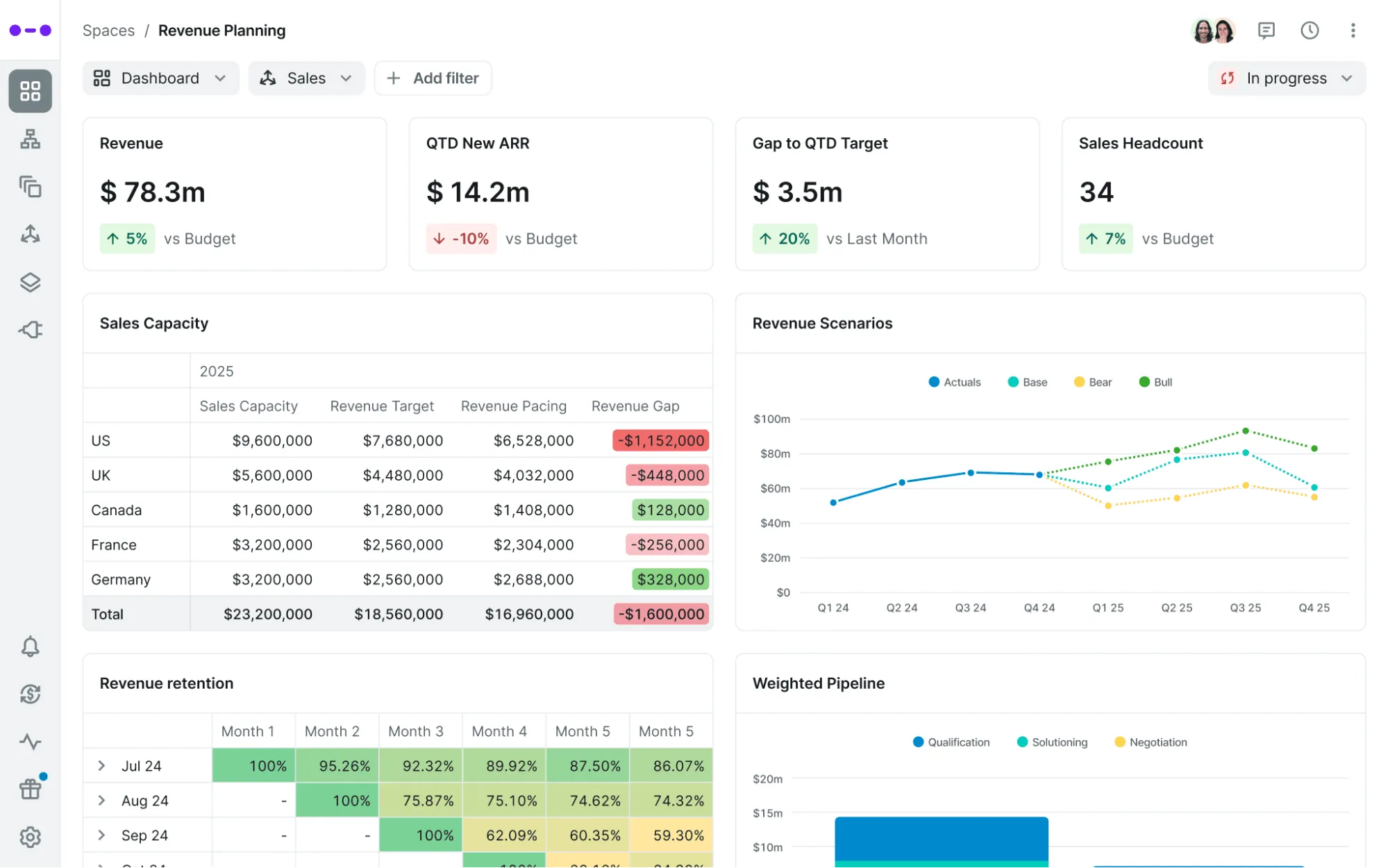
Abacum is an AI-native FP&A platform for mid-market companies and growing businesses seeking to modernize their financial planning without the complexity of enterprise-grade solutions. It combines the intuitive feel of spreadsheets with the power of advanced financial forecasting tools, bridging the gap for accounting and finance teams.
Image source: Rollup Consulting
Features
Abacum Intelligence: AI-powered forecasting that generates financial projections based on actual data, uncovering hidden patterns and dependencies
Real-time automated reports: Financial and operational metrics update automatically, providing accounting and finance teams with current insights without manual data manipulation
Multi-dimensional modeling engine: Conduct complex scenario planning and "what-if" analyses
Customizable dashboards: Build flexible models and reports specifically tailored to your company's needs, with ready-to-use charts
Collaborative workflows: Forecast templates, approval requests and team-based planning turn the forecasting process into a coordinated effort across multiple departments
Integrations: Connects with popular platforms including QuickBooks, Xero, Salesforce and HubSpot, creating a centralized database for all financial and operational data
Automated data consolidation: Streamlines data gathering from ERP, CRM and HRIS systems
Board-ready management reporting: Create professional investor reports with plan vs actual analysis and clean visual presentations
Customer feedback
Image source: G2
Users particularly praise its modern look and feel, ease of use compared to traditional forecasting software products, and flexibility in building custom models. Growing businesses appreciate how quickly they can implement the platform (typically 4 weeks) and the responsive customer support team. Several reviewers describe it as more "reporting-first" than a complete FP&A solution with advanced budgeting capabilities.
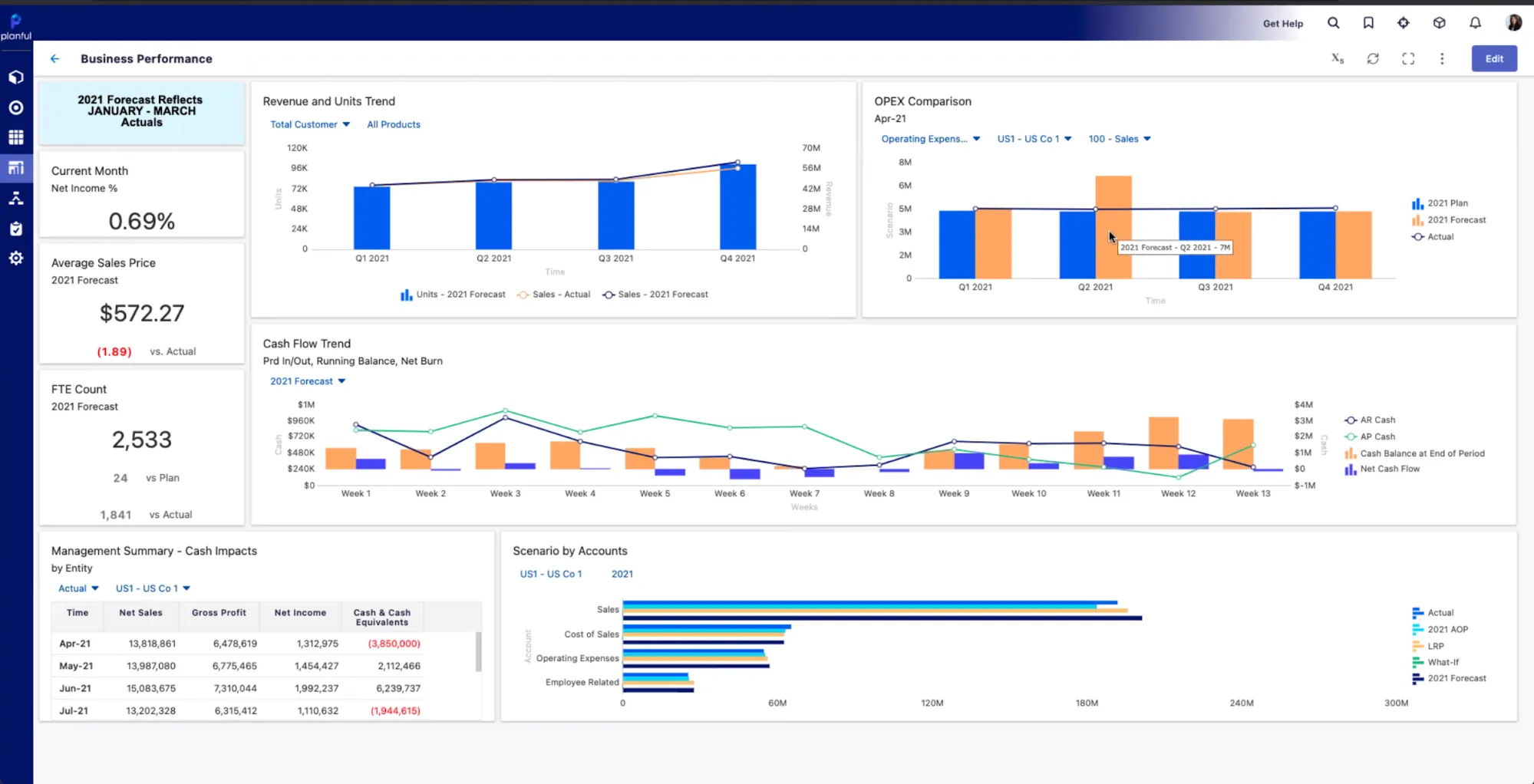
Planful
Planful is a comprehensive cloud-based FP&A platform designed for mid-market to enterprise organizations seeking end-to-end financial close, consolidation, budgeting and forecasting capabilities. This financial planning software offers a solution that transforms how CFOs manage complex financial processes.
End-to-end FP&A: Combines financial close, consolidation, reporting and planning in one unified platform, streamlining workflows for accounting and finance teams
AI-powered "Plan Assistant": Provides intelligent nudges and automated commentary in variance reports, helping teams interpret financial projections faster
Excel-like familiarity: Delivers spreadsheet-style syntax within the platform, reducing the learning curve for teams transitioning from traditional forecasting tools
Real-time scenario toggling: Quickly switch between best-case, worst-case and baseline scenarios to understand how different market trends might impact your business
Continuous planning: Enables cross-functional collaboration with HR, marketing, sales and operations teams contributing to financial plans through familiar interfaces
Workflow automation: Map consolidation steps, assign owners and trigger approvals, cutting cycle time and governance risk for complex organizations
Dynamic reporting/spotlight: Revamp budgeting and forecasting processes with flexible, template-driven reporting that adapts to changing business needs
Deep ERP integration: Connects with major platforms including NetSuite, Sage Intacct, QuickBooks and Microsoft Dynamics 365, creating a centralized database for all financial data
Consolidation module: Handles multi-company reporting with intercompany eliminations and multi-currency support, saving days off the financial close process
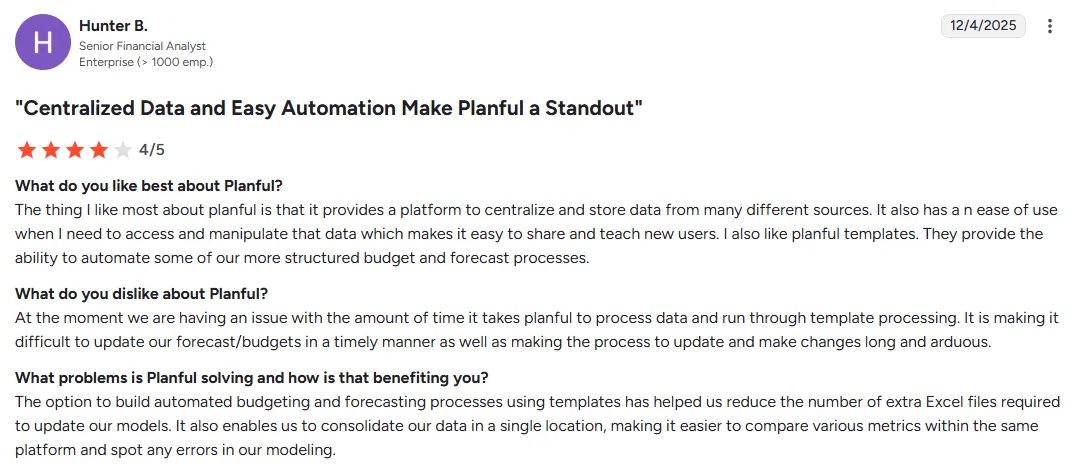
Customer feedback
Image source: G2
Users enjoy Planful's ability to centralize data from multiple sources and automate reporting processes. The platform's Excel-like familiarity makes it accessible to growing businesses while providing the sophisticated forecasting software products needed for strategic planning. Accounting and finance teams appreciate the automated budgeting templates that reduce reliance on external Excel files.
However, some users note a steep learning curve despite the familiar interface, with training materials needing improvement. The platform can experience slowdowns when processing large data volumes, and implementation typically takes a few weeks, with possible partner consultant requirements.
Mosaic
Mosaic (now part of HiBob) is a strategic finance platform specifically designed for SaaS companies, startups and small to mid-sized growing businesses. It simplifies financial planning through visuals, intuitive dashboards and real-time reporting, making it particularly attractive to teams who want to move beyond manual spreadsheets.
Image source: G2
Features
Real-time strategic finance: Consolidates data from ERP, CRM, HRIS and billing systems into a single source of truth, providing comprehensive financial projections updated automatically
Visual data dashboards: Intuitive, easy-to-read dashboards with statistical graphs and charts that simplify complex financial data for both financial and non-financial stakeholders
SaaS-specific metrics: Pre-built reporting for ARR, MRR, CAC, LTV and other SaaS KPIs with industry benchmarking, helping growing businesses track performance against market trends
Automated reporting & reconciliation: Eliminates manual consolidation work
Three-statement planning: Enables detailed scenario planning across P&L, Balance Sheet and Cash Flow statements with driver-based forecasting
Collaborative budgeting: Facilitates cross-departmental planning with easy dashboard sharing and stakeholder collaboration tools
Headcount & workforce planning: Includes built-in tools for modeling hiring plans and fully-loaded employee costs with HRIS integration
Version control: Ensures all users work with the most current data
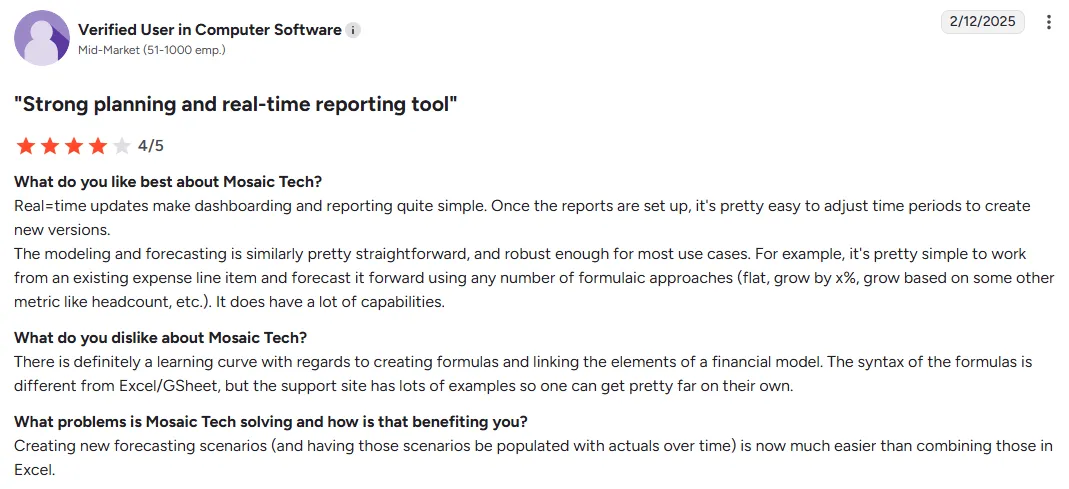
Customer feedback
Image source: G2
Growing businesses particularly appreciate Mosaic for its simplified approach to complex financial projections and the customer support from implementation through ongoing use. The platform's intuitive interface and visual appeal make it accessible to teams without extensive FP&A backgrounds.
However, users note some limitations. The platform is optimized primarily for SaaS companies, making it less suitable for non-SaaS businesses or complex organizations with diverse business models. Some find forecasting capabilities more restrictive compared to Excel, with customization options for reports and charts somewhat limited.
Fathom
Fathom is a cloud-based financial analysis, management reporting and forecasting tool that excels at transforming complex financial data into clear, visually engaging presentations. It's popular among accounting firms, business advisors, franchises and SMBs that need to create professional financial reports quickly while maintaining deep analytical capabilities for growing businesses.
Image source: Fathom
Features
Three-way cash flow forecasting: Generate precise financial projections across P&L, Balance Sheet and Cash Flow statements with driver-based forecasting and scenario modeling
KPI tracking & analysis: Pre-built financial and non-financial KPIs with the ability to create custom metrics using your own formulas
Multi-company consolidation: Handle complex organizations with multiple entities through features like intercompany eliminations, multi-currency consolidation and grouping financial statements
Benchmarking & ranking: Compare and rank multiple companies, clients or franchises across KPIs to identify top and bottom performers
Custom alerts & notifications: Automated notifications for key financial thresholds
Template library: Ready-to-use report templates and the ability to save custom templates
Scheduled report delivery: Automate report creation and delivery to stakeholders, putting your management reporting on autopilot
Customer feedback
Image source: G2
Users enjoy Fathom's simplicity, visual presentation quality and time-saving capabilities. The clean aesthetic and customizable reporting make it particularly valuable for client-facing professionals who need to present financial projections to diverse audiences.
Some limitations include a learning curve when importing data via Excel, limited graphic representation options compared to specialized data visualization tools, and restrictions on bringing in non-financial data from sources like Google Analytics or CRM systems without manual entry.
Scaleup Finance
Scaleup Finance is a comprehensive financial management platform for startups, scaleups and SMBs that combines automation with dedicated fractional CFO expertise. It offers a unique hybrid model that pairs cloud-based accounting solution technology with human financial guidance.
Image source: Scaleup Finance
Features
Fractional CFO services: Every client gets access to a dedicated, part-time CFO who provides strategic financial leadership, budgeting expertise and investor-ready reporting
AI-assisted forecasting: Leverages artificial intelligence to build financial projections quickly, with the CFO team providing oversight to ensure accuracy and credibility
Investor & board reporting: Professional, polished financial reports designed specifically for investor presentations and board meetings, helping growing businesses tell their financial story effectively
Real-time KPI dashboards: Customizable dashboards provide at-a-glance views of critical business metrics, financial performance and sales forecasting data
Consolidated reporting: Simplifies group reporting across multiple entities with automated consolidation from accounting, CRM, HR and marketing systems into a centralized database
Cash flow planning: Comprehensive cash management tools that monitor runway and project future cash positions
Fundraising support: CFO Partners handle due diligence preparation, financial model creation and pitch deck financials to help startups secure funding
Integrations: Connects with existing business systems to provide a unified financial view
Customer feedback
This tool doesn't have any reviews on G2 or Capterra yet.
Sturppy
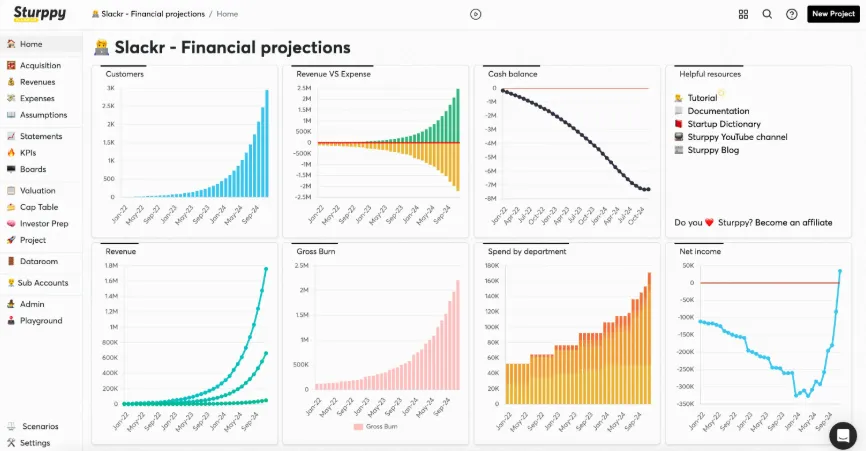
Sturppy is a modern, user-friendly financial modeling and forecasting tool specifically designed for early-stage startups and small to mid-sized growing businesses. It democratizes access to professional financial forecasting tools by enabling anyone to build investor-ready financial models without prior finance or Excel expertise.
Image source: Sturppy
Features
Sturppy planning: A guided model builder that walks users through creating custom financial projections tailored to any business model type
Sturppy plus (AI CFO): Advanced tier that creates an AI clone of your company's financial operations, automatically categorizing raw data and forecasting future performance through a ChatGPT-like interface
Real-time data syncing: Automatic daily synchronization with integrated accounting software keeps models current without manual updates
Multi-scenario planning: Build and compare different "what-if" scenarios within the same model to understand how various strategies impact your business, supporting sales forecasting and strategic planning
Collaboration tools: Invite teammates or mentors to collaborate on model building, ensuring financial plans benefit from diverse expertise
Shareable live links: Create branded, read-only model links for investors with visit tracking and feedback collection capabilities
DCF valuation calculator: Instantly assess business value using standard discounted cash flow methods, helping complex organizations understand their worth
Dynamic hiring planning: Project team growth trajectory over time with automated computations, integrating workforce planning with overall financial forecasting
Custom KPI tracking: Set up and automatically compute tailored key performance indicators specific to your business model
One-click export: Export financial statements individually or the entire model to formatted CSV files for use in Excel or Google Sheets
Customer feedback
Image source: Capterra
Users praise Sturppy for making financial modeling accessible and intuitive. Growing businesses appreciate the elimination of complex Excel formulas and the ability to adjust variables to see immediate impacts on their model. The onboarding videos and clear interface receive high marks for reducing the learning curve associated with traditional financial forecasting tools. At a significantly lower forecasting software cost than enterprise solutions, Sturppy provides an accessible entry point for startups looking to professionalize their financial planning.
Some users note limitations, including the lack of live integration with certain accounting software platforms, no documentation and poor support.
Best financial forecasting software & tools: selection criteria
Features
The financial forecasting software features you choose must fit your company's financial model and strategy needs. Consider whether you need a cloud-based solution for comprehensive corporate performance management, support for multiple departments, or supply chain integration.
Essential forecasting tools for efficient projections include:
Scenario analysis: Adaptability to changing variables helps you understand the impact of different market conditions or business decisions on future revenue and entire organization's performance
Automation and AI: Modern tools streamline data processing through automated data consolidation, trend identification and accurate forecast generation
Customization: Adjusting parameters, adding custom formulas and tailoring reports ensures insights that impact your company
Dashboard clarity: Evaluate screenshots provided — the reporting tool should deliver clear financial performance visibility to department managers and finance leaders
Integrations
Integrations ensure free-flowing information between your apps, supporting the entire organization. They minimize time-consuming manual data entry, reduce errors, improve accuracy and prevent redundancy through automated data consolidation.
Valuable integrations include:
Payroll systems: Connect human resources data for comprehensive workforce planning
Banks: Direct feeds for real-time cash management and sales data tracking
CRMs: Integrate customer data for future revenue projections
Ecommerce platforms: Track sales performance across multiple channels
Accounting tools: QuickBooks, Xero, Sage and other financial systems supporting the forecasting process
Industry-specific applications: Supply chain management, project management, and specialized tools for your sector
Customer feedback
Customer opinions provide insights into satisfaction levels with the reporting tool. Reviews reveal reliability and aspects that providers might not highlight, including:
Ease of implementation and the forecasting process
Quality of support for department managers and finance leaders
Actual performance of key features across the entire organization
Integration capabilities with accounting tools and human resources systems
Value for corporate performance management needs
Ready to up your financial forecasting game?
You can't ignore your finances if you want to build a successful business. But creating accurate financial plans doesn't have to mean headaches or sleepless nights. With the right financial forecasting software, corporate performance management becomes streamlined — even enjoyable.
Forget wasting time on spreadsheets and manual data input across multiple departments. Fuelfinance handles automated data consolidation for you, complete with automations that accelerate the forecasting process and expert support from finance leaders whenever you need it. Whether you're managing sales data, planning future budgets, or tracking financial performance across your entire organization, our AI-powered reporting tool, combined with fractional CFO support, delivers the insights department managers need to make confident decisions.
To see how to give your finances a glow-up with comprehensive management reporting, book a demo here.
FAQs
What is budgeting and forecasting software?
Financial planning is about making projections for near and far future budgets, expenses and future revenue of a company. A dedicated software solution for financial forecasts helps FP&A teams and finance leaders streamline these operations through automated data consolidation. It can pull, organize and analyze financial data automatically across multiple departments and cost centers, providing a clear understanding of your financial performance with minimal manual work. Modern financial forecasting software includes key features like AI-powered insights, scenario planning and management reporting.
What are the tools used in financial planning and forecasting?
Popular budgeting and forecasting software includes Fuelfinance, Anaplan, Jirav, Cube, Vena and Datarails. Other reporting tools not mentioned in this list include IBM Planning Analytics, Planning Maestro, Oracle Hyperion Planning and Workday Adaptive Planning (formerly Adaptive Insights).
What is the best tool for forecasting?
The best forecasting software for your financial and operational planning depends on your specific needs. For agencies and professional services, Fuelfinance stands out as a smart, automated and intuitive program that provides access to a team of financial professionals acting as your fractional CFO. It offers AI-powered financial planning, automated data consolidation from 350+ sources, natural-language dashboard creation and dedicated support from finance leaders.
How do you create a financial forecast?
Start with historical data collection from balance sheets, income statements, cash flow statements and operational metrics across sales data, cost centers and multiple departments. If you lack historical data, use industry trends and market research. Next, categorize the gathered information by relevant business drivers.
Based on organized data, create realistic projections using forecasting software that enables scenario planning for various outcomes. The best financial forecasting software lets you plan future budgets using both conservative and aggressive assumptions, supporting zero-based budgeting if needed. This is an ongoing process — update information regularly (weekly or monthly) to maintain accuracy.