See The New Fuel Live Recording


Imagine a CFO who never sleeps, never makes emotional decisions and can process more financial data in three seconds than your entire finance team does in a month.
Imagined? Well, it still wouldn't beat a human CFO who knows your business through and through. But it can help them a lot!
Now imagine that robotic CFO working side by side with your human team — combining deep business understanding with real-time insights (and never forgetting a decimal point).
That’s what an AI CFO looks like. Not a robot in a suit. Not a replacement for your finance leader. Just a better way to make decisions, faster.
And it’s already happening.
The CFO's role is evolving with new tech adoption, requiring financial executives to juggle endless numbers, manage ethical considerations and drive organizational change.
CFOs are becoming strategic leaders, driving business growth and leading the adoption of new technologies. They need help. And AI is already here to drive that business transformation.
An AI CFO is a Chief Financial Officer who uses artificial intelligence (AI) tools to plan, analyze and report faster and better. Don’t worry — it’s not a replacement. It’s an evolution of the CFO role. AI models analyze financial data, identify trends and support decision-making by providing predictive analytics and potential risk assessments.
It’s 2025; finances are not what they were ten years ago. Teams are remote. Systems are in the cloud. And leaders are expected to make decisions in real-time, backed by current data. AI for finance enables CFOs to enhance financial and operational efficiency.
An AI CFO doesn’t just look at last quarter’s numbers. It predicts next quarter’s risks. It explains why revenue dropped, not just that it did. It connects tools like CRMs, ERPs and spreadsheets into one dashboard. And it finds the patterns humans miss.
Large language models are a core technology enabling advanced AI CFO capabilities, allowing for secure and customizable interactions with organizational data. They don’t rely on weekly spreadsheets or quarterly reports. They use real-time financial dashboards, forecasts and anomaly detection to create financial summaries and automate reporting tasks.
Human CFOs still lead strategy, handle funding conversations and build relationships — but now, they’re supported by automation and smart tools that eliminate grunt work and make data usable. AI also enhances forecasting and automates compliance and auditing to reduce errors, providing valuable insight for strategic decision-making.
Before AI, CFOs spent hours digging through spreadsheets, chasing down numbers and preparing reports. Now, they can spend that time on decisions. The primary role of AI is automating routine tasks and enabling human executives to focus on higher-value activities that improve financial performance.
Traditional finance workflows were slow. By the time reports are ready, current data has already changed. With AI forecasting tools, CFOs can predict trends based on data pulled from accounting tools and act early. Regular insights from AI empower finance leaders to lead with precision and confidence towards sustainable growth.
Fuelfinance, a financial automation platform, helps companies do just that. It builds AI-powered forecasts using your historical data — revenue, costs, net profit and more. These forecasts update automatically and appear as accurate graphs and tables, easy to understand and interpret.
You don’t need to wait for month-end. The data’s already there, whenever you need it.
With our AI financial analysis, you can:
Fuelfinance includes an AI Copilot. You can ask it questions like:
The generative AI Copilot will answer instantly, and even generate graphs in seconds. It integrates with all your tools — ERPs, CRMs, spreadsheets — so you don’t have to worry about manual uploads.
Markets shift fast. With Fuelfinance, you can model “what-if” situations without waiting for analysts. For example:
The system shows you how that affects runway, cash flow and growth targets. Fuelfinance lets you view those answers in graphs and spreadsheets immediately. That means faster responses and fewer surprises.
AI helps CFOs explain complex data to CEOs, COOs and board members in meetings, improving investor relations. AI solutions tailored for the C-Suite enable senior executive management to make informed strategic decisions backed by clear, actionable insights. Instead of sending a 50-tab spreadsheet, you can send a clear dashboard or report with plain-language summaries. Non-finance leaders will love it.
Fuelfinance even creates AI financial summaries and tips, so you can get a narrative version of your metrics, perfect for investor updates or board meetings. We trained it using lessons from 100+ CFOs and 300+ clients.
Here’s what happens when finance teams go AI-first.
Manual reporting used to take days. AI reduces that to minutes. With Fuelfinance, routine reports are automatically generated and sent to you. That’s the time you can spend on analysis, or just catching your breath.
One Fuelfinance client, ColdIQ, used to spend days on manual reporting. After switching to Fuelfinance, they reduced their close time by 60%.
AI learns from your data. It catches patterns you might miss and updates forecasts based on real results. You can build monthly, quarterly or annual projections — and compare them side by side with what actually happened.

With AI tools, finance can work more closely with sales, marketing and product to plan smarter. CFOs who combine their strategic vision with AI insights and key skills guide their organizations effectively.
Here’s what it looks like inside our own team, as explained by our Founder, Alyona Mysko:
“I open one dashboard to see Plan vs Actual across the whole company. If something’s off, I look for reasons. If we’re burning too fast, I know why. Investor updates take 15 minutes. Not a weekend project.
You don’t need a huge finance team or expensive consultants. Fuelfinance acts as your outsourced CFO with AI handling the heavy lifting, so your internal team can focus on strategy. For fast-growing companies, that’s a big deal.
AI is significantly reducing operational costs by automating repetitive tasks, accelerating fraud detection and more. Industry surveys report that 36% of financial services professionals have seen AI decrease annual costs by over 10%. The same study notes that AI technologies could potentially deliver up to $1 trillion of additional value annually in the finance sector.
Here’s what CFO technology actually does, summarized. We also looked for some actual tools to help you build an efficient CFO tech stack.
|
Use case |
What AI does |
Tools |
|
Forecasting |
Automates revenue, expenses, cash flow prediction |
Fuelfinance, Pigment, Datarails |
|
Variance analysis |
Flags anomalies, explains variances in plain language |
Fuelfinance, Cube |
|
Scenario planning |
Runs “what-if” simulations on demand |
Fuelfinance, Mosaic |
|
Board reporting |
Auto-generates slides, KPIs and narrative insights |
Fuelfinance |
|
Workflow automation |
Automates approvals, alerts and reminders |
Ramp, Airbase |
|
Fraud detection & risk scoring |
Flags suspicious activity using pattern detection; supports governance by ensuring oversight and compliance in AI-driven financial processes |
NetSuite AI, Tipalti |
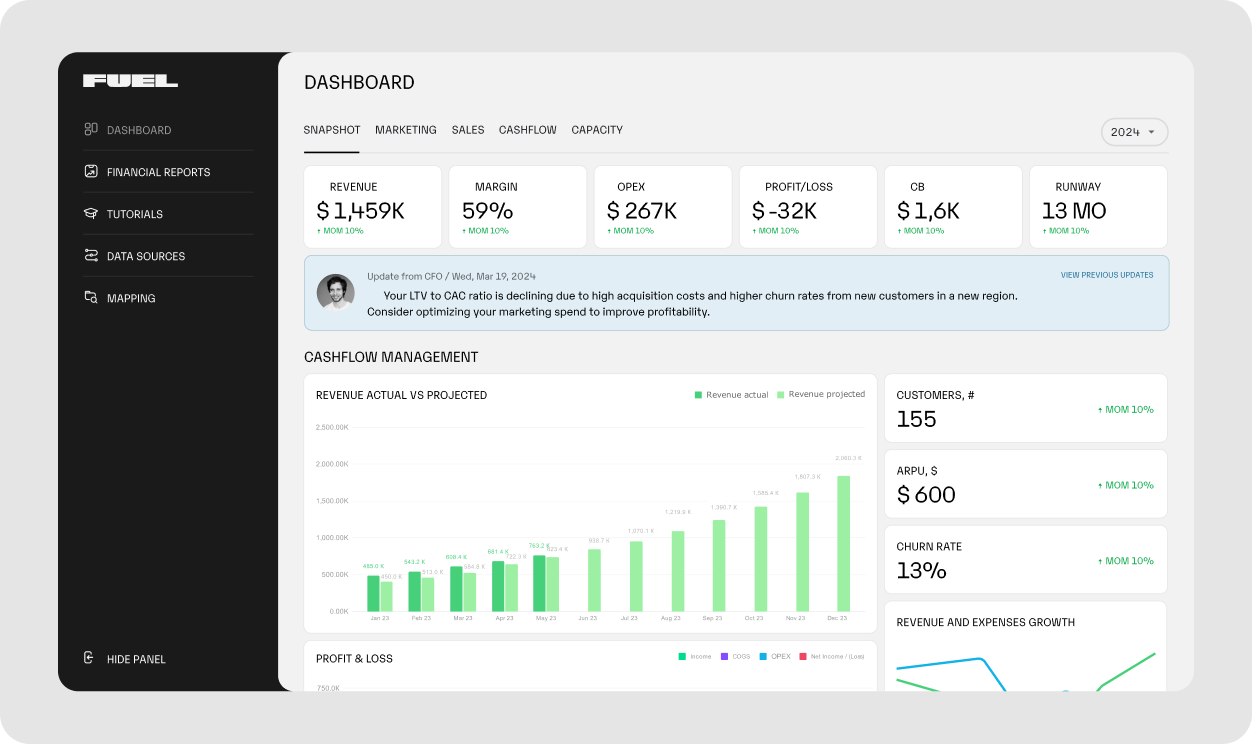
Fuelfinance is your cloud-based financial department. It’s one of the best FP&A software options that combines a web-based dashboard, AI forecasting and expert support to give you full control over your company’s finances — without the complexity.
Here's what you get:
Fuelfinance helps companies from pre-seed to Series B and beyond — from lean startups to growing SMBs that want to increase their value proposition and direct their corporate strategy towards optimized performance.
You’re heading into a board meeting. You ask the AI Copilot for your Q2 forecast vs actuals, customer churn impact, and CAC trendline. It builds the graphs for you.
Then, it creates a summary of the key insights — you copy and paste it into your board deck.
That’s not a future feature. That’s how Fuelfinance works today.
CFOs used to be the last to know. Now, financial leaders are the first to act.
AI isn't a threat to the finance function in companies — it's the upgrade. The real risk is falling behind.
Fuelfinance gives you the tools to work faster, see clearer and plan smarter, using an AI strategy, advanced tech and support from finance professionals — without hiring a huge team or building custom dashboards.
👉 Book a demo and see how the AI CFO can work for you.
AI tools use historical data to predict future outcomes. Fuelfinance, for example, builds projections for revenue, costs and cash flow using advanced analytics — and updates them automatically as new information comes in to analyze data effectively and plan your financial operations accurately.
Fuelfinance connects with over 350 tools, including CRMs, ERPs, billing platforms and spreadsheets. It pulls your data in and turns it into dashboards, forecasts and reports.
Hampton, Testimonial Hero and ColdIQ all use Fuelfinance AI tools to automate reports, track unit economics and improve financial visibility. Check out our case studies to learn more about their success.
An AI integration in your tech stack can monitor industry trends, analyze data and spot unusual patterns before they become problems. It can be used anywhere from capital markets analysis to assessing business value. Fuelfinance’s anomaly detection flags outliers in real time — helping you catch fraud, overspending or reporting issues fast while developing effective risk mitigation strategies.


Just imagine how that would transform your team’s productivity and focus? Talk to our financial experts to know more.