See The New Fuel Live Recording


If you're still wrestling with manual financial reports while your competitors are automating them in minutes, you're not just behind — you're burning money.
An ai financial report generator does what you wish your intern could do: pull complex data from multiple sources, spot trends you'd miss and create stunning documents faster than you can say "balance sheet." We're talking real-time data, automated workflows and meaningful insights a few clicks away.
In this article, you'll discover the 10 best AI financial report generator tools that are saving founders 15+ hours weekly. Plus, you'll learn which one fits your specific needs.
An AI financial report generator automatically connects to your accounting software, bank feeds, ERPs and any other financial data sources you're using. No more manual CSV uploads or copy-pasting. It pulls everything together in real-time, handling large datasets and creating a single source of truth.
Next, the system validates and cleans your data automatically. It catches duplicates, flags anomalies and fixes inconsistencies that would normally take hours to find. Financial automation reduces reporting risks linked to human error.
Then, machine learning algorithms analyze your complex financial data to identify trends and patterns, spotting risks and opportunities you might overlook.
Finally, generative AI creates narrative summaries with visual elements that explain what's happening in your finances. Instead of staring at rows of numbers, you get clear insights about what's driving your revenue, where costs are creeping up and what you should focus on next. You can often customize these reports.
The difference between basic automation and true AI-powered intelligence? Basic tools just move data around. AI actually generates valuable insights, makes predictions about your business growth and helps you create impactful reports that make a lasting impression on key stakeholders.
Let's talk real numbers. Here's what happens when you ditch manual reporting for an ai financial report generator:
According to Yvonne McGill, CFO at Dell Technologies, "When AI is applied strategically and with discipline, it reduces costs, drives innovation and productivity, unlocks new revenue streams, and flows through the P&L with better operating income and earnings per share."
Here's how the top tools stack up for creating actionable insights:
Let's dive deeper into these options to help you make wiser, data-driven decisions.
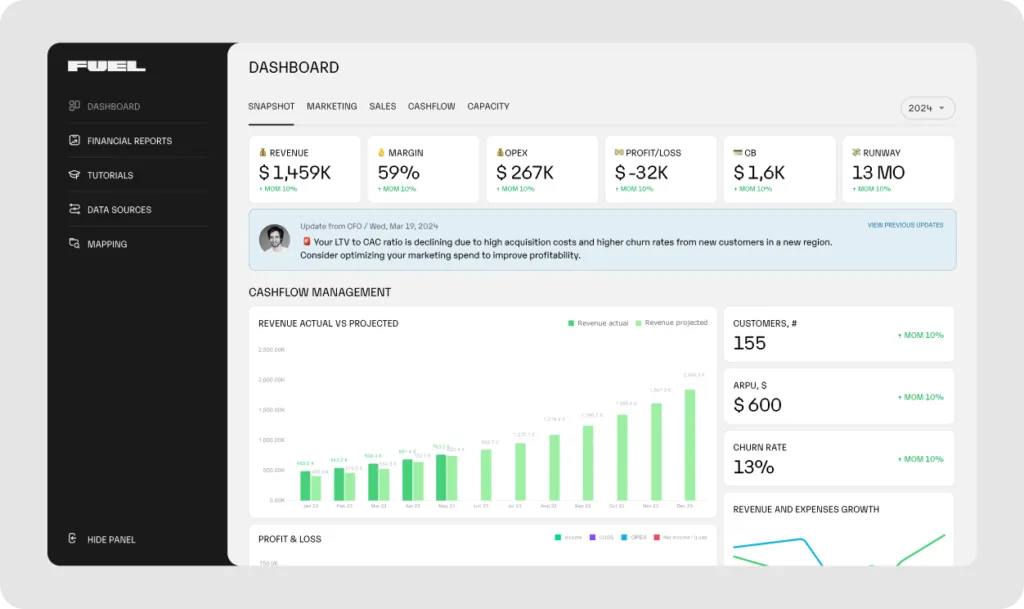
Fuelfinance is your cloud-based financial department. Instead of spending weeks on integrations and months learning complicated software, you get an intuitive interface that's up and running fast, combining proprietary software with real financial professionals.
Plus, we actually have a free AI report generator where you just upload your financial data, KPIs and benchmarks. You get a pre-designed report with:

For the report to be nice and pretty, you need clean data, though. And if you need help with data cleanup or financial analysis, get the full Fuelfinance version with access to:
Beyond the AI features, you get automated workflows, unit economics tracking and a dedicated financial manager who actually understands your business.
Check out our AI report generator that lets you create impactful reports instantly using simple prompts. If you want full Fuelfinance access, hit us up for a demo.

Pigment is the heavyweight champion of AI-powered business planning. If your finance, sales and ops teams need to work from the same playbook, Pigment makes it happen with AI muscle and advanced features.
The platform's agentic AI proactively analyzes your data, automating reports and spotting risks. It scans across your business to detect patterns and surface meaningful insights automatically. Pigment runs scenario simulations and gives you recommendations. It handles data cleaning, transformations and formula generation.
You can ask questions using natural language like "What happens if we miss Q2 targets by 15%?" and get instant financial projections showing the impact. The AI maintains your models in real-time as business conditions change, so your forecasts stay relevant.
See also: Pigment competitors

If your team lives in Excel and Google Sheets, Cube gets it. This AI report generator doesn't force you to abandon your spreadsheets — it supercharges them with AI.
Cube AI works alongside you proactively. It suggests projections based on historical trends and automatically populates your models with predicted values.
The automated variance analysis compares plan vs. actual, identifies drivers and generates explanations without manual work. You get AI forecasts, flexible scenario modeling and automated data validation that catches errors. The visual elements make it easy to spot trends and communicate key points to key stakeholders.
The platform pulls complex data from your ERP, CRM and payroll systems into a unified view. Your CFO dashboard updates in real-time.
See also: Datarails vs Cube
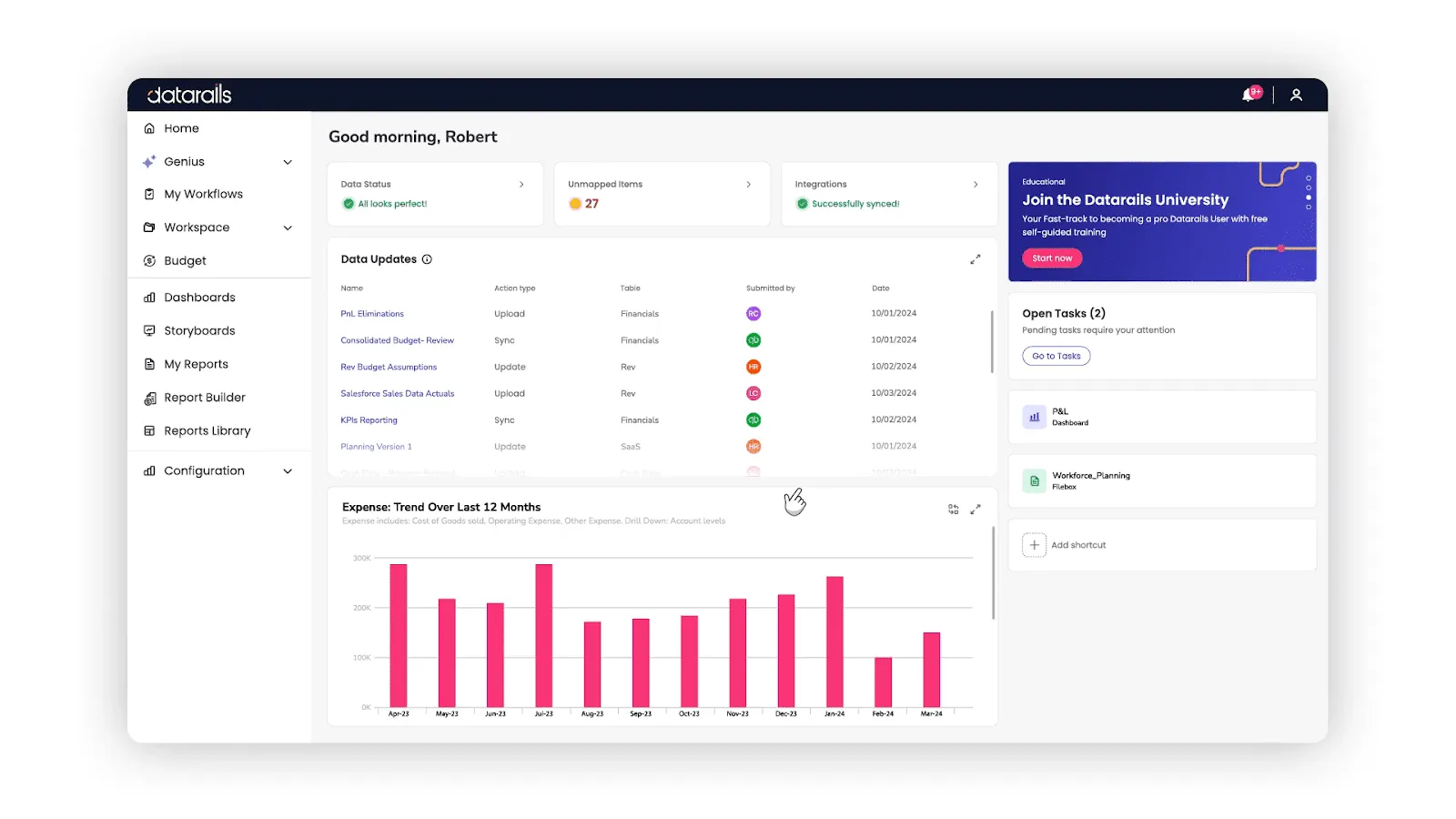
Datarails extends Excel with advanced features. FP&A Genius AI lets you ask direct questions using simple prompts and get instant, accurate answers.
The AI automatically consolidates data from multiple sources, validates for inconsistencies and creates dashboards with visual elements that update in real-time. It works for SMBs that don't have huge finance teams but still need sophisticated financial reporting software.
The platform includes tools for budgeting and forecasting, month-end close, cash management, data analysis and consolidation, as well as financial reporting.
See also: Datarails competitors
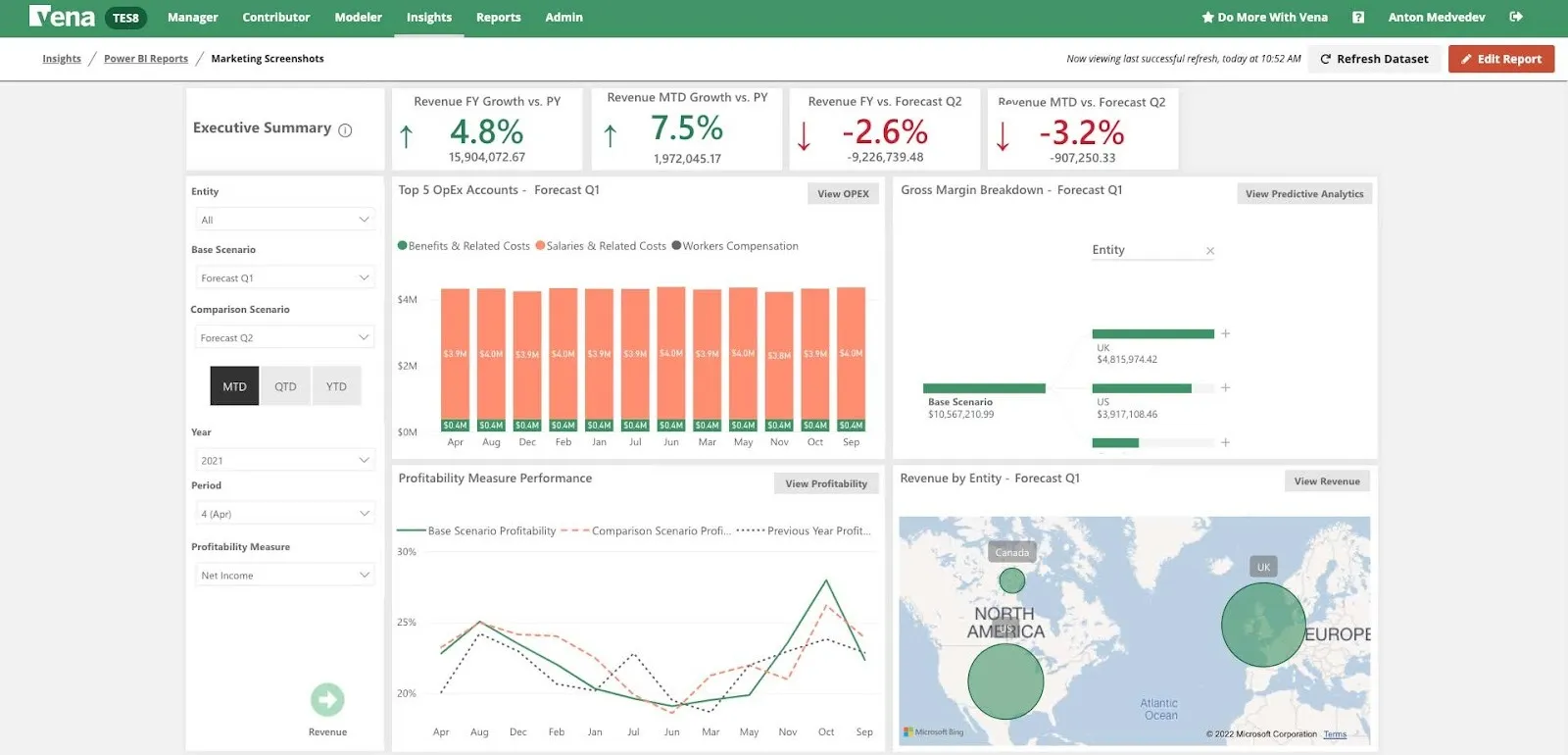
Vena is the Microsoft 365 of FP&A platforms. If your company runs on Excel, PowerPoint and Teams, Vena integrates seamlessly with those tools.
You can request financial data, generate reports or create presentations using conversational prompts and simple commands. The AI adapts over time by learning from your business's financial history, delivering more personalized reports and meaningful insights.
The platform handles budgeting, forecasting and financial consolidation. Version control, audit trails and role-based access keep everything secure and compliant, giving you full control over which documents get shared internally and what information goes to external key stakeholders.
Vena has pre-built templates for different industries and use cases, so you're not starting from scratch when creating reports. You can easily customize report types based on audience, whether you're preparing client updates or investor documents.
See also: Vena competitors

Prophix transforms financial reporting with advanced features and analytics. This AI financial report tool automatically generates insights, identifies patterns and turns traditional reports into interactive communication tools.
The conversational AI assistant lets you ask questions like "Why did forecasted revenue drop this month?" and get instant answers identifying key drivers and emerging trends.
Predictive forecasting uses machine learning on your historical data to generate baseline forecasts. You can compare best-case and worst-case scenarios, stress-test assumptions, and adjust drivers to keep forecasts aligned with market conditions.

Tableau Agent is a conversational assistant that lets you type queries using simple prompts and get instant visualizations that make complex data understandable. Your sensitive financial data stays secure with masking, audit controls and compliance features.
The platform's forecasting capabilities use time series models to project future values from historical data. Tableau automatically selects the best model, improving accuracy without manual tuning. You can create forecasts directly in line charts and embed them into dashboards.
The tool delivers natural language insights and metric alerts into your workflow. The anomaly detection and clustering features help you spot patterns and outliers automatically, surfacing critical insights without manual digging. Unlike simpler tools like Piktochart AI or WPS AI that focus on basic visualization, Tableau offers more advanced features for transforming raw data into insights.

Mosaic makes financial modeling conversational. It analyzes your data, identifies the drivers and presents findings visually with key points highlighted. The automated insights turn complicated model exploration into quick conversations.
Mosaic compares planned vs. actuals, pinpoints underlying drivers, generates explanatory narratives and helps you reconcile differences. The platform provides real-time data, analytics and planning across finance, sales and operations. Integration with major systems means your reports and metrics are live on day one without technical resources required.

Anaplan is the enterprise heavyweight with serious AI and more advanced features than you'll likely ever use. If you're running complex financial models across multiple business units, geographies or scenarios, it delivers the advanced analytics you need.
It combines connected planning with machine learning capabilities. Anaplan uses forecasting techniques to analyze your historical data and generate accurate predictions for financial and operational metrics.
The system can analyze different types of data simultaneously, improving forecast accuracy and relevance. The intelligent engine continuously updates forecasts, helping you keep up with market trends. You get personalized reports based on different scenarios, all with full control over assumptions and drivers.
Anaplan's strength is in flexible modeling for complex organizations. You can connect financial planning with sales, supply chain and workforce planning in real-time. The platform handles multi-entity consolidation, intercompany eliminations and scenario modeling.
See also: Anaplan competitors

Planful simplifies recurring forecast cycles and decision-making for mid-market finance teams with AI.
The platform uses historical data to create reliable baselines, monitors inputs and outputs for potential issues and makes scenario exploration simple through advanced analytics. Ensemble forecasting combines multiple AI models to improve prediction accuracy, while anomaly detection flags unusual patterns before they become problems.
Conversational AI lets you ask questions using simple prompts in natural language and get insights immediately. The platform integrates with ERPs and other source systems, automating data collection and validation. No matter how many reports different departments need, the system handles them efficiently, creating personalized summaries that can be easily customized.
Planful handles the full FP&A workflow: budgeting, forecasting, consolidation and reporting. Pre-built templates for different industries mean faster implementation.
See also: Planful competitors
Ready to stop drowning in spreadsheets and start making informed decisions based on meaningful insights?
Your competitors aren't working harder — they're working smarter with AI handling report generation and busy work while the creative team focuses on strategy and meaningful insights. Will you be ahead of them or scrambling to catch up?
Book a Fuelfinance demo and see how AI can save your finance team 24 hours monthly while creating reports that deliver critical insights and operational efficiency.
How accurate are AI-generated financial reports compared to manual reporting?
AI-generated reports made in specialized tools are significantly more accurate than manual methods. Financial automation reduces reporting errors by 90%, eliminating common mistakes like data entry errors, redundancy, formula mishaps and copy-paste inconsistencies. AI validates complex data automatically, catches anomalies and ensures consistency.
However, AI accuracy depends on the quality of your input data — garbage in, garbage out still applies. The best approach combines cost-effective AI automation for report generation with human oversight for critical insights and strategic decisions. Tools with advanced features like data cleanup and anomaly detection surface key points that need attention, while advanced analytics help you make informed decisions confidently.
Do I need accounting knowledge to use an AI financial report generator?
Not really. Modern ai financial report generators are designed for founders and business owners, not just CPAs. Tools like Fuelfinance use conversational AI where you ask questions using simple prompts in plain English and get clear answers with visuals.
That said, basic financial literacy helps you ask better questions and interpret results correctly. Most platforms offer templates, guided workflows and explanations that teach you as you go. If you're serious about growing your business, pairing AI with a fractional CFO availabla at Fuelfinance gives you both automation and strategic guidance.
What's the difference between accounting software and AI financial report generators?
Accounting software records transactions, manages books and produces basic financial statements. It's your system of record for day-to-day operations. An AI report generator connects to your accounting software plus all your other data sources (bank accounts, payment processors, CRM, etc.) to create comprehensive, up-to-date, personalized reports with analysis, forecasting and critical insights.
Can I customize AI-generated reports to match my specific business metrics?
Absolutely. Every business is different, which is why the best tools with advanced features offer extensive customization, custom illustrations and tracking metrics specific to your industry. You can build custom dashboards with visual elements, personalized KPIs and design reports that match how you think about your business. AI adapts to your business model, not the other way around. Fuelfinance allows you to model whatever you need with natural language input, saving time through automation and improving operational efficiency.


Just imagine how that would transform your team’s productivity and focus? Talk to our financial experts to know more.



.webp)