See The New Fuel Live Recording


Your bank balance says $200K. Your books say you're profitable. So why did payroll almost bounce last month?
Traditional spreadsheet forecasting can't keep pace with real-time business complexity, leaving finance teams scrambling to explain where the money went (or will go). AI cash flow forecasting changes that, though.
Let's find out how modern AI-powered forecasting works, and how platforms like Fuelfinance deliver accurate forecasts without the usual implementation headaches. Stick around to see how they affect forecast accuracy, implementation timelines and whether AI beats hiring another analyst.
Traditional cash forecasting requires finance teams to pull data into spreadsheets, build manual formulas and make educated guesses about timing. One misclassified transaction or forgotten invoice throws off the entire forecast. You could spend hours on manual work, only to watch the forecast become outdated the moment business conditions shift.
AI-powered forecasting flips this. The system connects directly to your ERP systems, accounting software, bank accounts and payment processors. It learns how your customers actually pay (not when they're supposed to), spots trends humans miss, and updates forecasts in real time as new financial data flows in.
AI cash flow forecasting uses artificial intelligence and machine learning to predict future cash positions based on pattern recognition across multiple data sources, like your historical financial data and real-time data integration from different business management tools. AI analyzes your transaction history, identifies payment patterns, detects seasonal trends and generates accurate forecasts automatically without you having to manually build formulas and update static reports.
Modern solutions like Fuelfinance make this accessible without a data science team or months of integration work. The AI handles complexity—multiple revenue streams, payment delays, seasonal patterns—while you focus on strategic decision-making rather than spreadsheet maintenance.

Instead of having to manually pull data from various sources, the AI automatically syncs transaction history, invoices, accounts receivable, accounts payable and bank balances. After setting up your Fuelfinance account, the system first connects to your existing financial infrastructure. It integrates with over 350 tools, including QuickBooks, Xero, Stripe, PayPal, major banks, ERP systems like NetSuite and Microsoft Dynamics, and CRM platforms like HubSpot and Salesforce.
This real-time data integration means your forecast updates continuously. A payment hits your account at 2 PM? The forecast adjusts immediately. An invoice gets sent? The AI predicts when cash will actually arrive based on that customer's historical payment behavior. Teams get real-time visibility across all cash positions without logging into multiple systems.
Fuelfinance models analyze your cash movements over months and years. The AI identifies seasonal trends, payment patterns, customer behavior and operational rhythms you didn't know existed.
The system also detects anomalies. If a regular payment comes in 40% below normal or a vendor suddenly changes payment timing, the AI flags it for review.
Your forecast isn't static. As new financial data flows in from multiple sources, the AI recalibrates predictions. Market conditions shift? The system adapts. Payment terms change? Forecasts update automatically. This continuous learning means improving forecasting accuracy over time—the longer the AI runs, the smarter it gets.
Fuelfinance's AI also incorporates external context: macroeconomic trends, industry benchmarks and seasonal factors affecting your sector. If your industry typically sees payment delays during certain periods, the AI factors that into future cash positions. The platform runs on secure cloud infrastructure, ensuring enterprise-grade data protection and processing speed.
Generally, a good forecast has a deviation under 10% in any side (lower or higher). But, in reality, it depends on the time horizon, and the variables linked to it (Fuelfinance also gives you a confidence score, not just the numbers):
The AI automatically creates a scenario plan. Best case (that enterprise deal closes on time), worst case (three major clients delay payment), and baseline scenarios appear side-by-side. You can compare multiple forecast scenarios instantly without rebuilding spreadsheets.
Our AI-driven forecasting doesn't just predict cash flow—it tells you what to do about it. The system provides variance analysis (forecast vs actuals), early warning systems for liquidity issues, and specific recommendations, e.g., "Based on current trends, you'll hit minimum cash reserves in 28 days. Consider accelerating collections from these three clients or delaying this vendor payment."
What happens when your data is incomplete? We know that most SMBs don't have perfect historical data. Fuelfinance's AI fills gaps using anonymized patterns from thousands of similar businesses. If you're missing 6 months of customer payment history, the system uses benchmarks from comparable companies in your industry to generate reliable forecasts while your own data accumulates.
You may be thinking: Does AI replace the CFO, then? Not even close. CFO validation improves the AI, creating a feedback loop that generates greater accuracy over time.
The CFO catches errors the AI misses—wrong assumptions, misclassified transactions and context the machine learning models can't access or industry experience robots lack. Each correction becomes labeled training data that improves future predictions. More importantly, CFOs bring business context AI can't see: upcoming contracts not yet in the system, known seasonal patterns specific to your clients, one-time events or strategic decisions about to impact cash flow.
Well, with Fuelfinance, you get both: tools to automatically update and analyze your financial performance, plus a dedicated finance leader who understands your business and helps you make sense of it all.
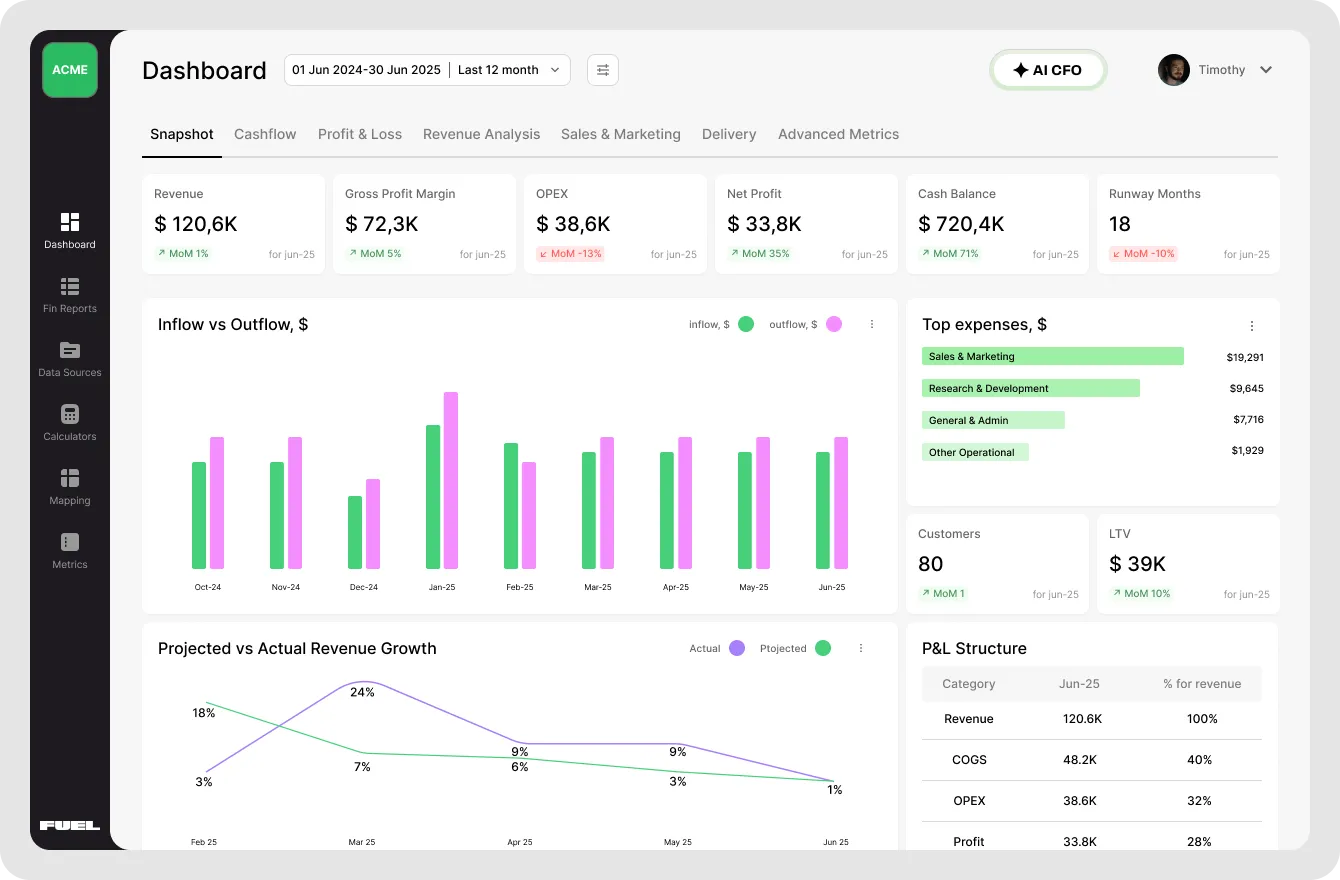
That's not all, though. Fuelfinance also gives you access to:
Instead of spending days building spreadsheets that are outdated by the time they're finished, your treasury and finance teams get accurate forecasts that update continuously, an AI scenario analysis that helps you test decisions before making them, and actionable insights that drive informed decisions.
Implementation typically takes around two weeks—not the months required by enterprise FP&A software platforms designed for multinational corporations. Just connect your existing systems and watch the numbers come to life.
Sign up for a demo and get greater confidence in every financial decision you make.
Forecast accuracy depends on time horizon and data quality. Short-term forecasts (0-30 days) typically achieve ±5-10% accuracy, medium-term (1-3 months) hit ±10-15%, and long-term (3-12 months) land in the ±15-25% range. Fuelfinance provides reliability scores with every forecast, so you know exactly how confident the AI is about specific predictions. The system also shows variance analysis comparing forecasts to actual results, allowing teams to track and improve forecasting accuracy over time.
Fuelfinance implementation averages two weeks from signup to first forecasts. The platform connects to your existing financial systems through pre-built integrations, so there's no complex data migration or lengthy setup process. The AI starts analyzing your historical financial data immediately and begins generating forecasts within days. Traditional financial management systems can take months to implement and require dedicated IT resources.
AI handles the repetitive pattern recognition, data processing and forecast generation that consumes most of an analyst's time. But human expertise is still important for interpreting results, adding business context and making strategic decisions. Many finance leaders find the best approach combines AI-powered forecasting with experienced CFO support—exactly what Fuelfinance delivers. You get full automation for data work plus expert guidance for strategy, at a fraction of the cost of a full-time hire.
When market conditions shift—customer payment behavior changes, vendor terms adjust, seasonal patterns evolve—the AI continuously recalibrates forecasts based on the latest information. Fuelfinance also incorporates external economic data and industry trends, helping the AI account for broader market shifts. For truly unprecedented events (pandemic-level disruptions), the platform's scenario planning tools let you model different possibilities and adjust assumptions manually, combining AI efficiency with human judgment for risk management. This approach helps treasury teams make more informed decisions even during unsteady periods.


Just imagine how that would transform your team’s productivity and focus? Talk to our financial experts to know more.