See The New Fuel Live Recording


In spring 2026, when our founder and CEO Alyona Mysko named her newsletter The Finance Engineer, we couldn’t have imagined that companies like Figma and Mercor would soon be hiring for the role and paying up to $250K for it.
The pay gets attention, but many leaders we talk to aren’t sure what the role covers. When they think about investing in finance automation, they expect it to become one more burden on their plate, sitting next to the hundreds of tasks their finance team is already drowning in.
So let’s walk through the basics: what a finance engineer does at Fuelfinance, with real examples of how it works for our customers.
A finance engineer is a finance professional who builds the workflows, AI agents, and automations your finance team runs on, so nobody has to do every step by hand. They know GAAP, the close, and the forecast. They can also connect systems, write the rules down, and ship a tool your team uses next month. It’s a finance role, not an IT role; in every posting we’ve reviewed, it reports into Finance.
A year ago the role barely existed. Now it has job postings, salary bands, and a name that analysts and investors use. Below we cover why it showed up in 2026, how it differs from the quant “financial engineer,” what the work looks like, what it pays, and whether your team needs one.
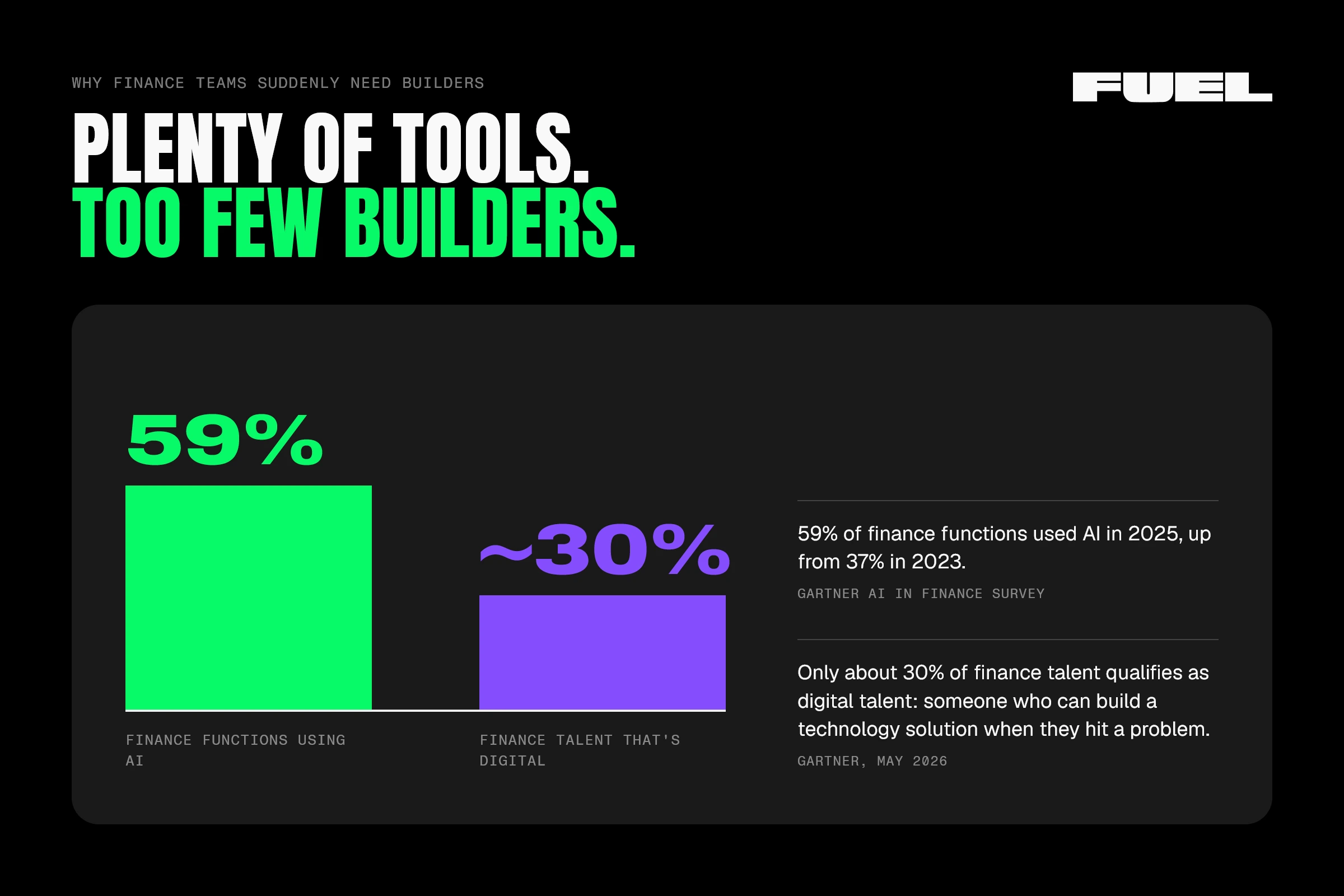
Finance has more AI budget than people who can put it to work. Gartner found that 59% of finance functions used AI in 2025, up from 37% in 2023. Spending keeps climbing too: Bain’s 2026 CFO survey found 83% of CFOs plan to raise AI budgets by more than 15% over the next two years. The tools showed up. The people who can turn them into running workflows didn’t.
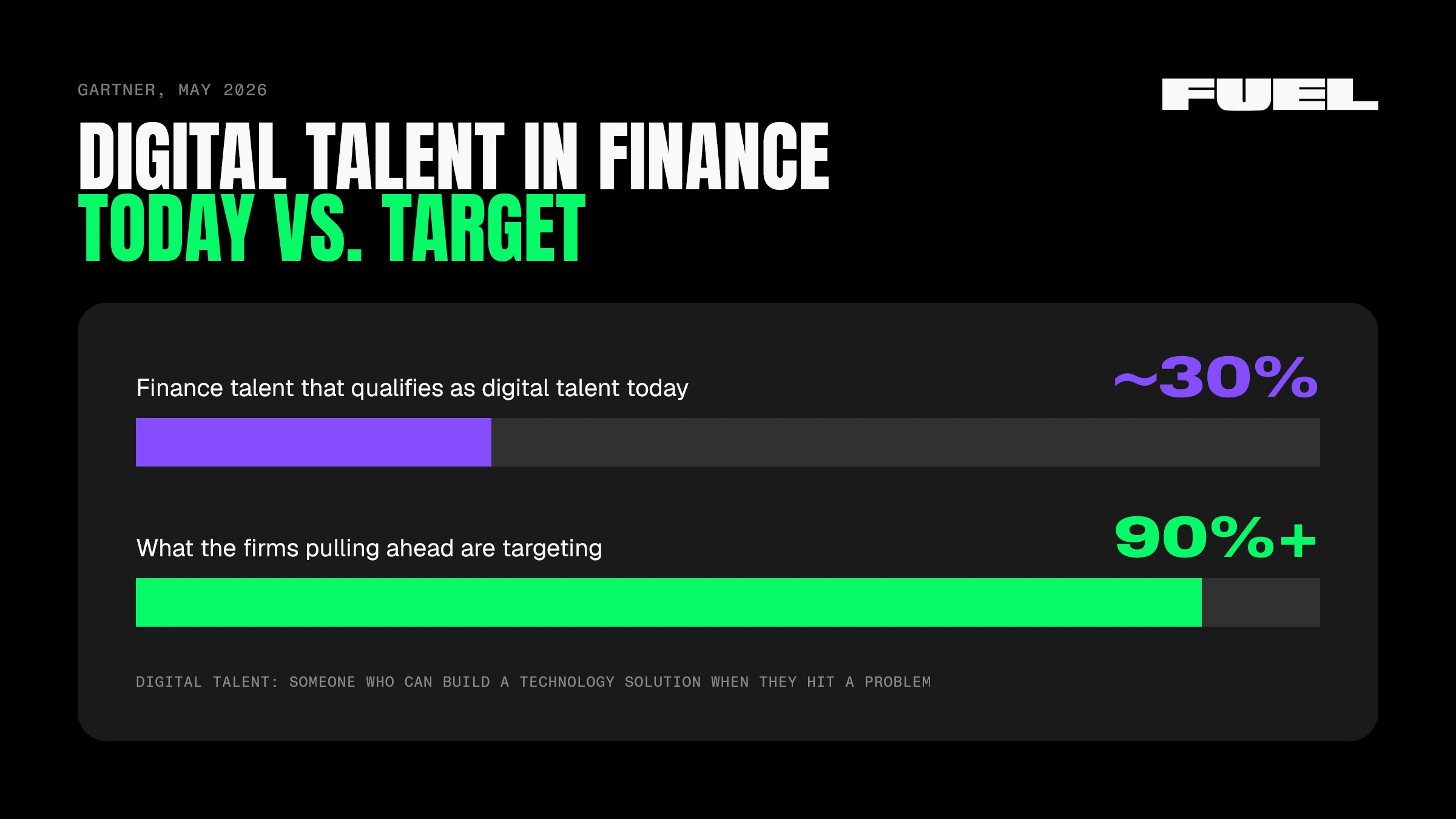
Gartner research presented in May 2026 puts a number on that gap. Only about 30% of finance talent qualifies as digital talent, meaning someone who can build a technology solution when they hit a problem. The firms pulling ahead are aiming for 90% or more. When Gartner surveyed 100 CFOs in early 2026, acquiring and developing AI and digital talent came out as their top near-term challenge. In an earlier Gartner survey, only 42% of CFOs said they were confident they could hire and keep digital talent in finance.
The pressure isn’t limited to CFOs. In the 2026 Finance Architecture Survey from FEI’s research foundation (116 senior finance executives, October 2026), half named the talent and skills gap as the single biggest threat to their function. That’s twice as many as named the next concern. Yet only 10% invest aggressively in upskilling, and 11% invest nothing at all. The traditional pipeline won’t close the gap on its own either: the AICPA’s 2025 trends report found the supply of new accounting graduates is still shrinking.
Hiring has started to shift. In a Wolters Kluwer survey of 392 finance leaders, 85% said AI skills matter when they recruit for finance, and 11% called them essential. Gartner predicts that by 2028, 20% of finance organizations will stop hiring and developing talent that isn’t digitally literate.
Then the market gave the gap a name. In October 2026, a16z’s “You Need a New CFO” listed the rise of the finance engineer as a shift it hadn’t predicted: “The most advanced finance teams are not only using AI software tools but building their own automations.”
If you searched for this term and landed on derivatives pricing, you found the other meaning. Let’s untangle the two.
Search results for this term still lean toward the older meaning. Financial engineering is a quantitative discipline: pricing derivatives, building structured products, modeling risk with stochastic calculus. It lives in banks, hedge funds, and master’s programs, and it has nothing to do with closing your books.
The finance engineer is a 2026 role inside the corporate finance team. Here “engineer” describes how they work, not the math they do. They treat the finance function as a system you can build and maintain.
There’s also a third meaning you’ll run into when you talk to vendors, us included: an outside finance engineer who builds a company’s agents together with its team.
The clearest description we’ve seen comes from the job postings themselves. In June 2026, a $3.3B Series E healthcare company posted the role with this brief: automate the month-end close; design AI agents for forecasting, reconciliations, revenue recognition, and accruals; build dashboards that update on their own; evaluate AI vendors; and run the finance stack, from NetSuite to FP&A software. The KPIs were concrete: close time down 30%, manual work down 30–40%, forecast accuracy up 20%. The must-haves were GAAP, modeling, internal controls, and, in the posting’s own words, “a software engineering mindset.”
In practice, the work splits into two halves.
The building half gets most of the attention. A finance engineer maps a process with the person who runs it, writes down the rules that only lived in that person’s head, and turns them into a workflow: agents that read the bank files, match them to the ledger, and hand a person the exceptions.
The governance half is what keeps it all running. Our experience shows that managing agents matters more than building them: where each skill is stored, how its context gets updated when the business or the model changes, and who owns it when it breaks during close. At Fuel, that means a shared repository for skills and a separate one for company context, a registry with an owner and a status for every skill (idea, testing, validated, standardized), and two review rounds before anything touches a live close.
Here’s how that plays out on a real process. At Lasko Products, a 120-year-old US manufacturer, a staff accountant used to spend three to four hours a day, sometimes up to six, classifying bank and ERP transactions across 16 bank accounts. One of our finance engineers sat down with that accountant and wrote down how each row got classified and which exceptions mattered. Then they built a chain of four agents: a GL classifier, a bank classifier, a register updater, and a review dashboard. Unclear rows went to an exception queue for a person. A few months in, the daily cash position was ready in under 20 minutes, 89% less time than before, and 95–99% of transactions were classified automatically.
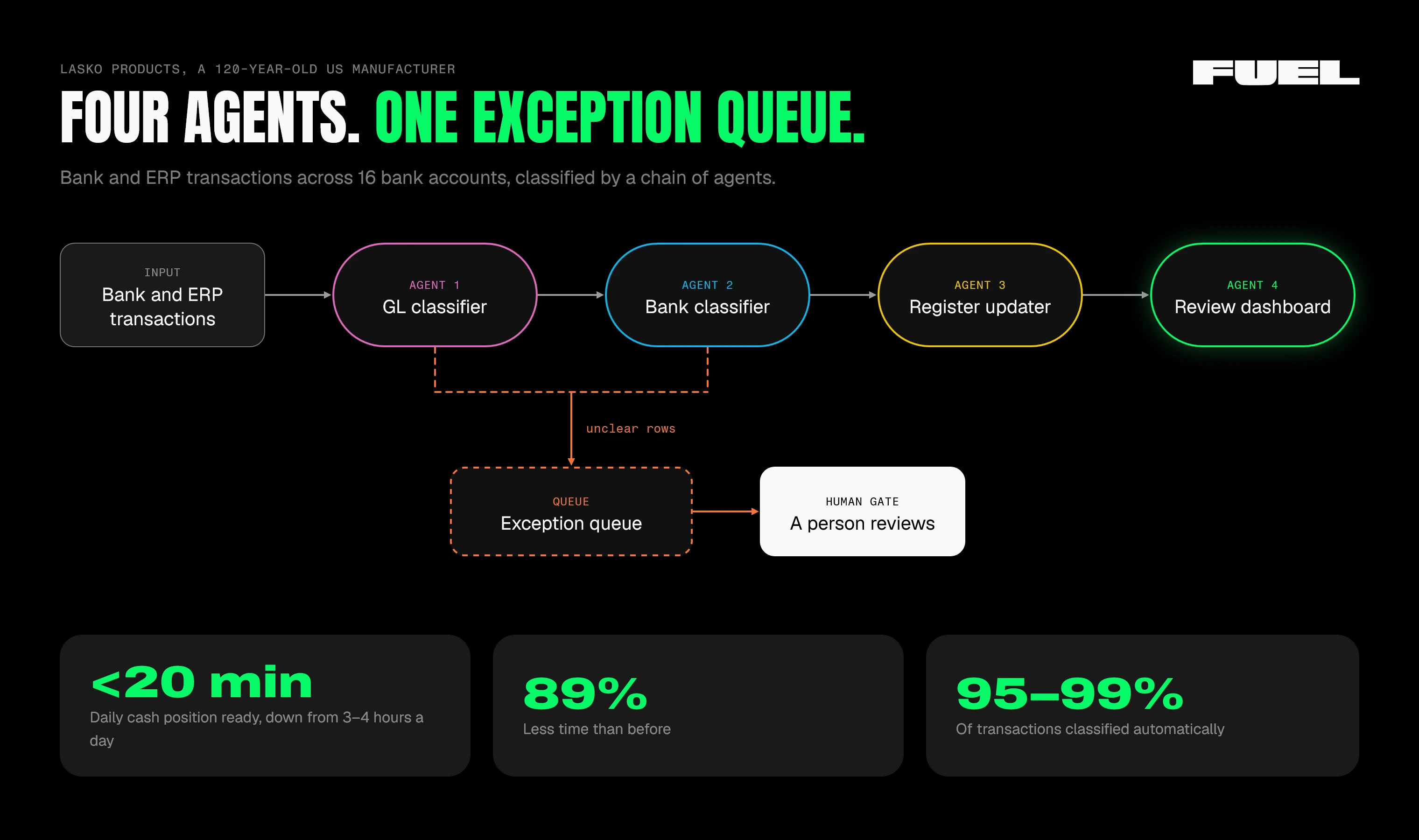
The accountant kept their job. They just spent far less time matching rows and more on the exceptions.
Skills are the visible part. Mindset decides whether those skills turn into something your team can trust.
Here’s a test we use to split the work:
Would two different people doing this task by hand get the same answer?
If yes, the rules can be written down and the task should run as code. If not, it needs judgment, so it gets an agent and a reviewer.
Earlier this year we reviewed finance engineer postings and here’s what we found:
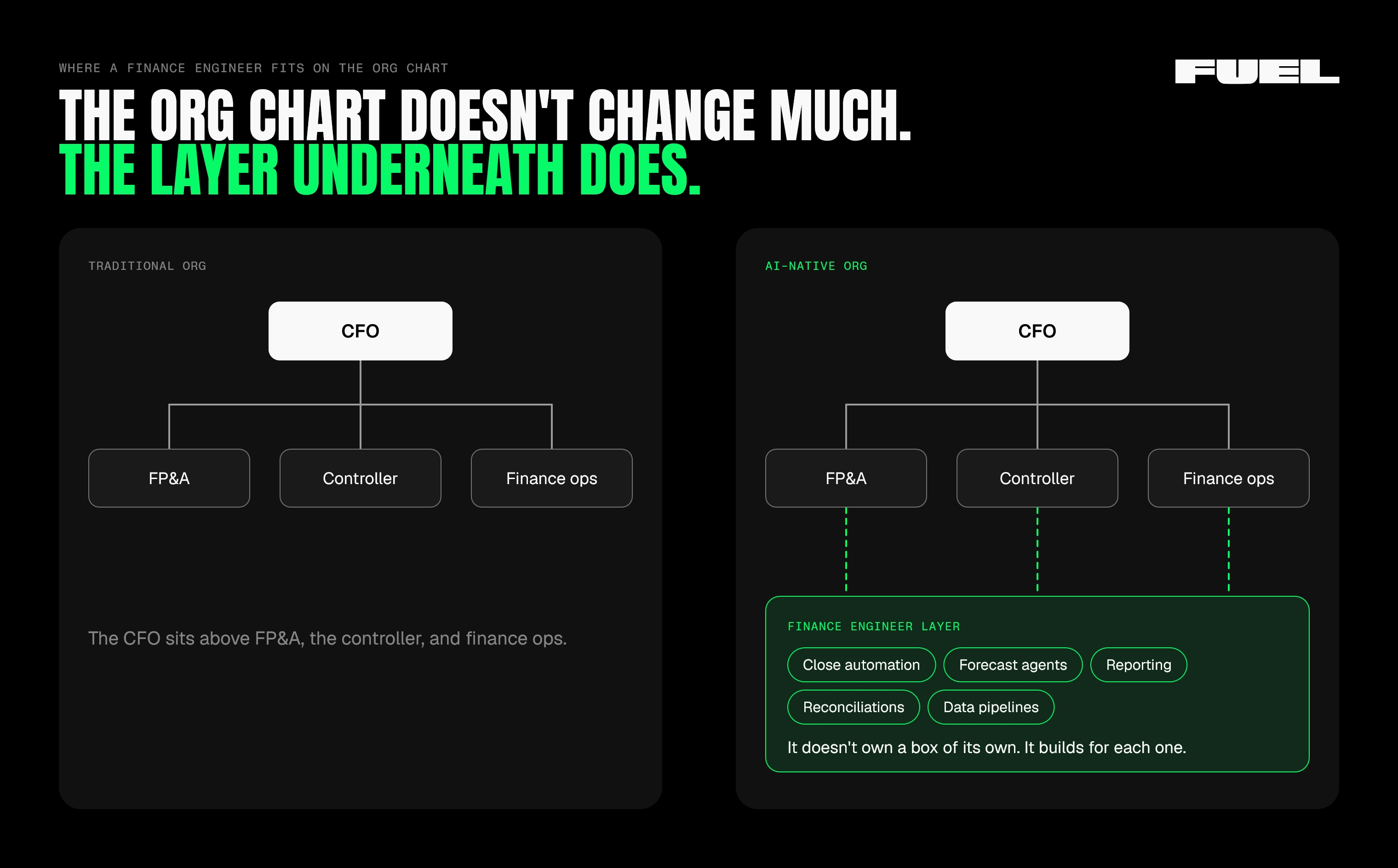
The org chart doesn’t change much. Your CFO still owns the board, FP&A still forecasts, and the controller still closes. What changes is the layer underneath.
In a traditional org, the CFO sits above FP&A, the controller, and finance ops. In an AI-native org, those same four boxes stay, and a finance engineer layer runs across all of them: close automation, forecast agents, reporting, reconciliations, and data pipelines. It doesn’t own a box of its own. It builds for each one.
So where do these people come from? Usually from inside finance: senior financial analysts, FP&A managers, controllers, heads of finance, and the occasional CFO who still builds. Our own finance team at Fuel started adopting AI from almost zero in March 2026. Seven months later, most of the team had built agents and five people had become finance engineers. At Chargebee, Finance Director Neerav Patwa saw three to four finance engineers emerge on their own during the team’s 12-month move to running 50+ agents and automations.
The trend has support from outside, too. In August 2026, OpenAI CFO Sarah Friar listed finance professionals becoming builders as one of her lessons from building an AI-native finance function. In October, a16z’s “You Need a New CFO” described the scarce CFO skill as designing the finance operating system (data, workflows, agents, controls) and noted that Anthropic’s finance team maintains 70+ finance AI skills.
It depends on where your team is today and how many processes you want to move.
This makes sense when you have three or more recurring workflows you want on agents, a finance team big enough to keep a builder busy, and a CFO ready to set the rules for what gets built and who checks it. A finance engineer pays off when there’s a backlog. Without one, a single builder ends up making one-off tools.
Go this way if someone on your team already builds on weekends. They know your chart of accounts and your exceptions, which is the hard part. Give them time, a shared repository, and a reviewer.
This works in three cases, and they can overlap:
It’s the model we run at Fuel. Our finance engineer maps one process with your team, builds the context, and runs the workflow on three to five past periods until it matches your signed-off numbers. Then we run the first month with you and train your people to control and extend it.
That’s likely if your close takes two days, your data sits in one system, and nobody is losing hours to re-typing. Automate what hurts. If nothing hurts, a new role is just overhead.
Want to see what a finance engineer would build first on your close? Book a 30-minute process map with one of ours.


Just imagine how that would transform your team’s productivity and focus? Talk to our financial experts to know more.