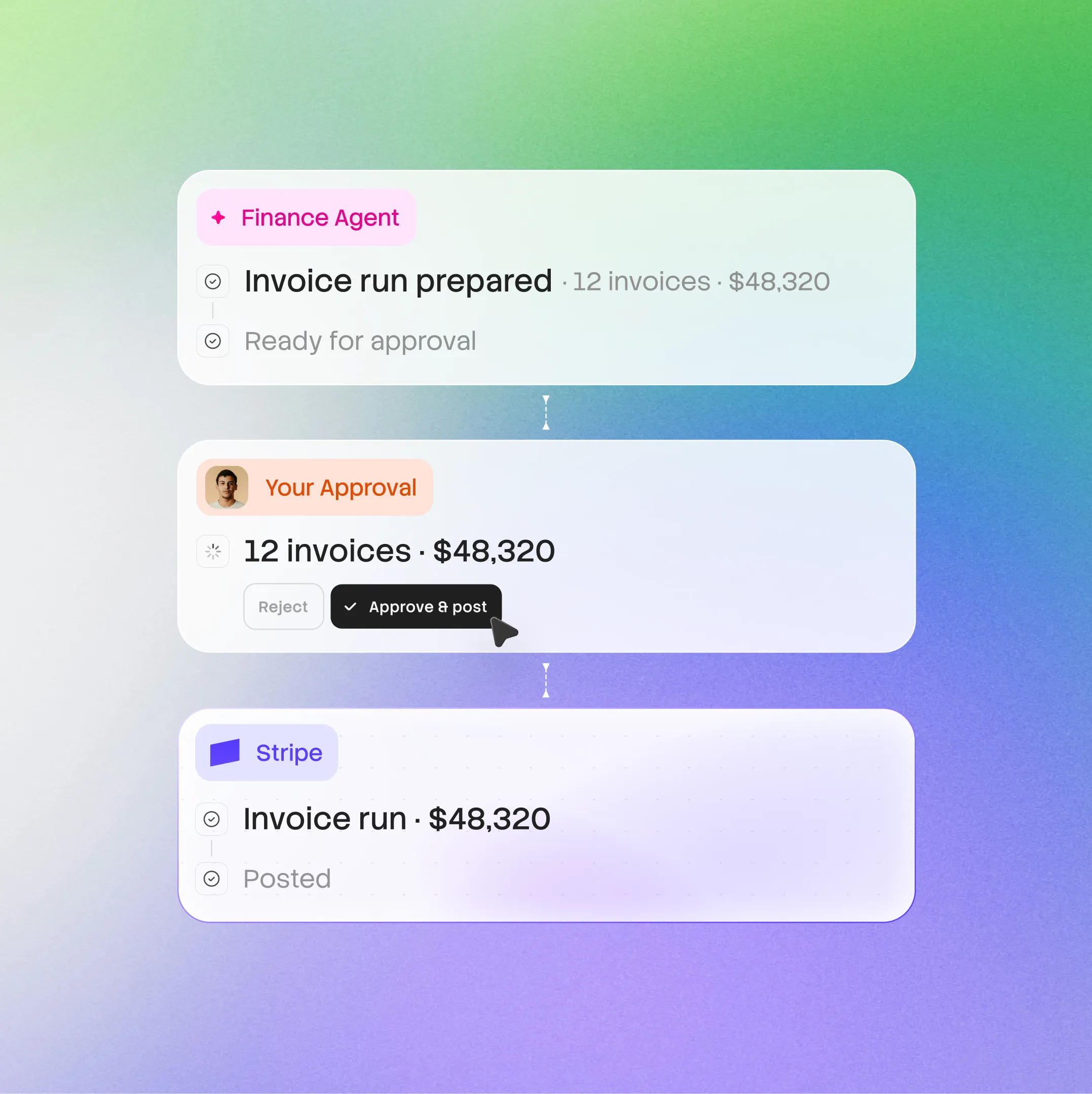


Multi-agent workflows that run on your schedule, update their own context, and talk to you in Slack or Teams.
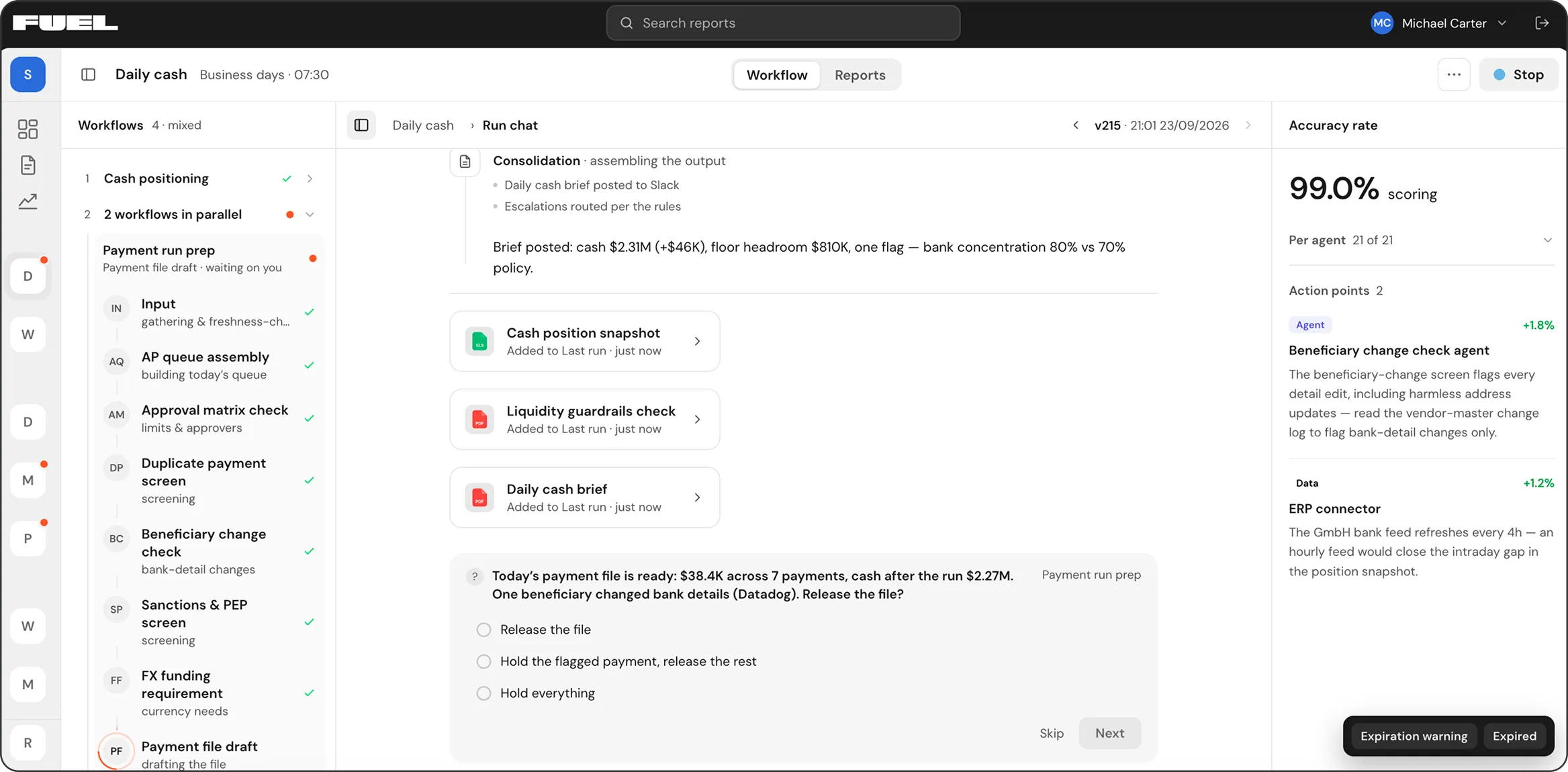
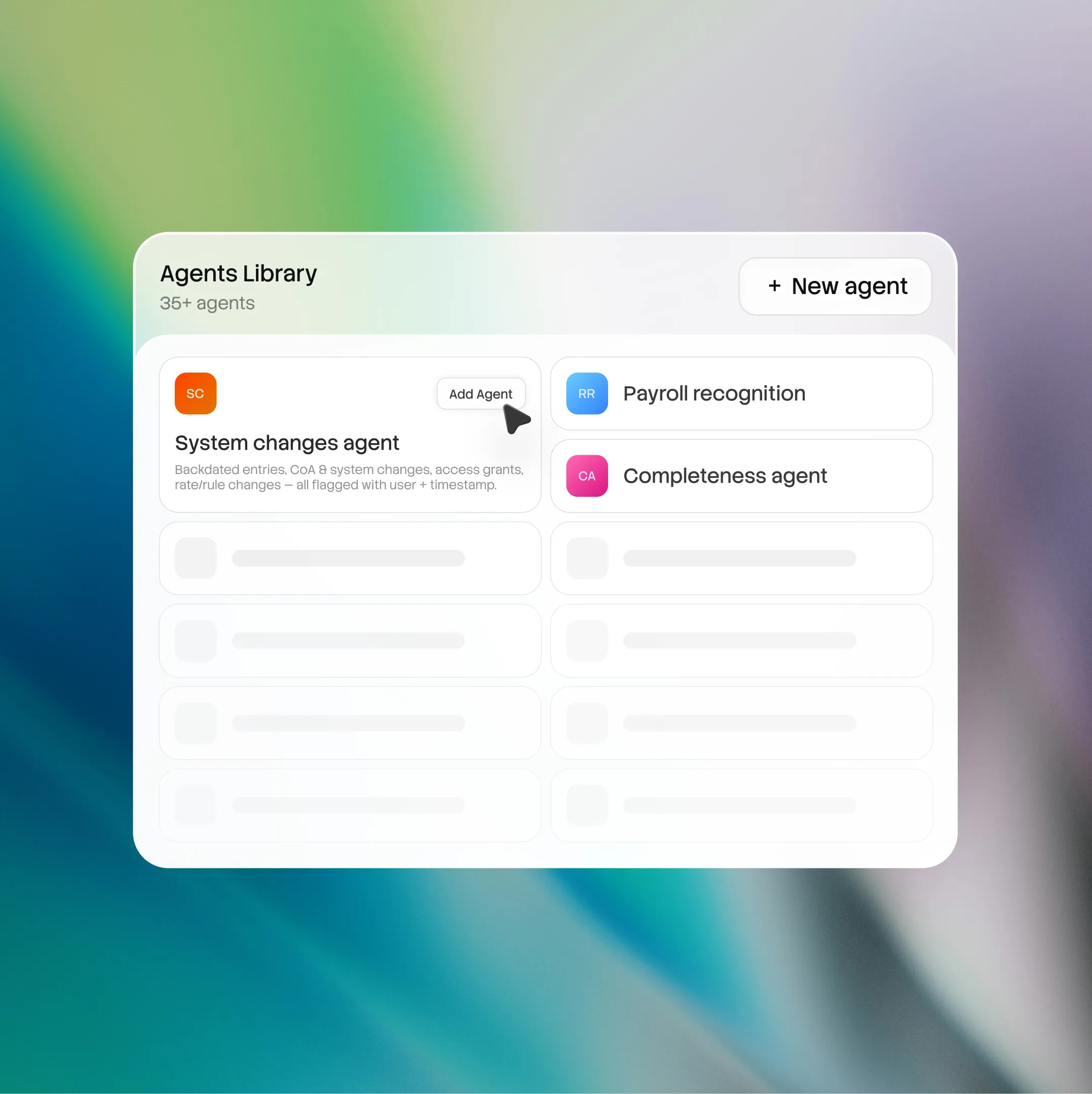
Every agent does one task: match revenue to invoices, check payroll rolls forward, decompose a P&L. Choose from 35+ or build a custom one.
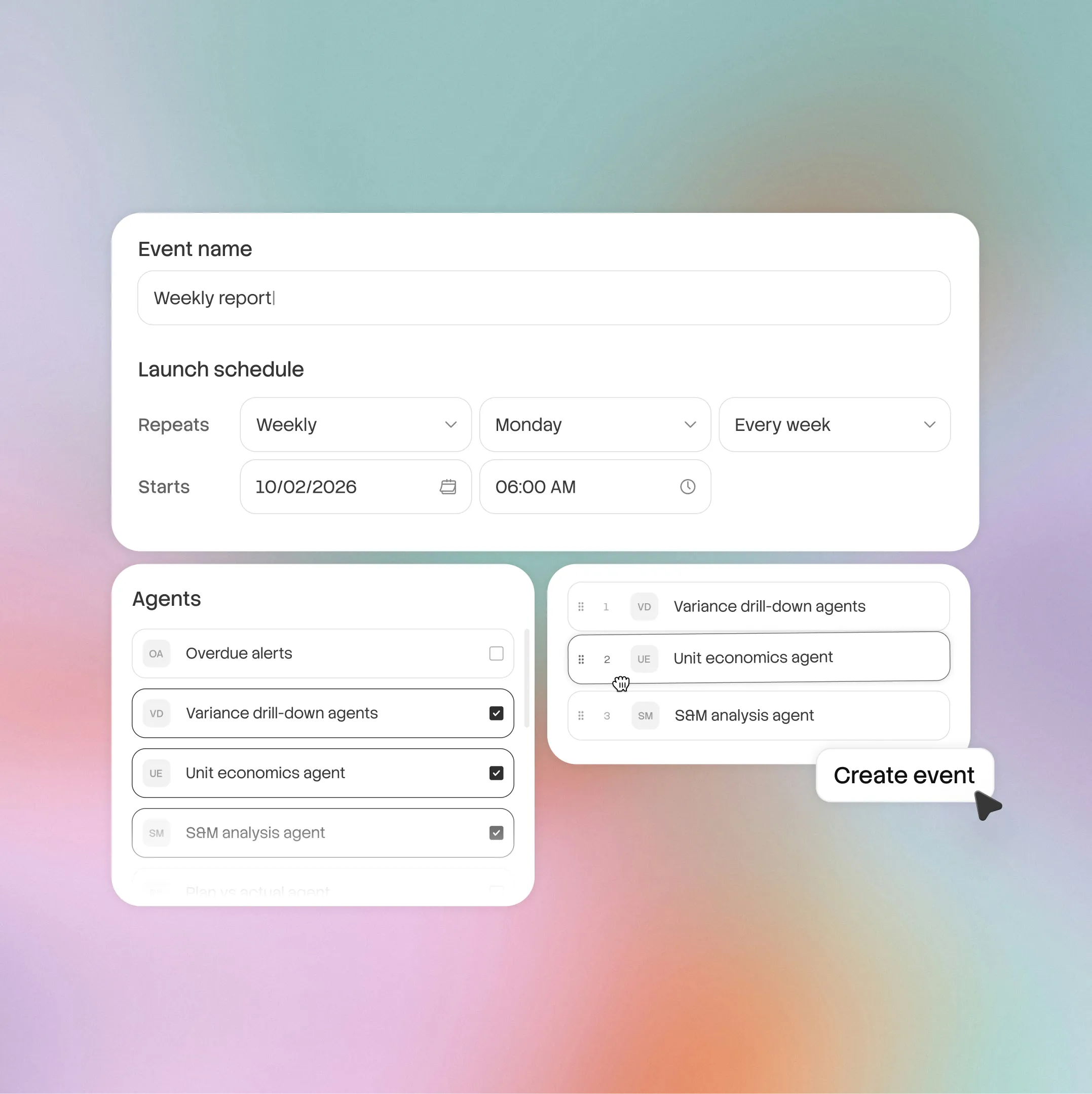
Pick the agents, set the run order, set the schedule.
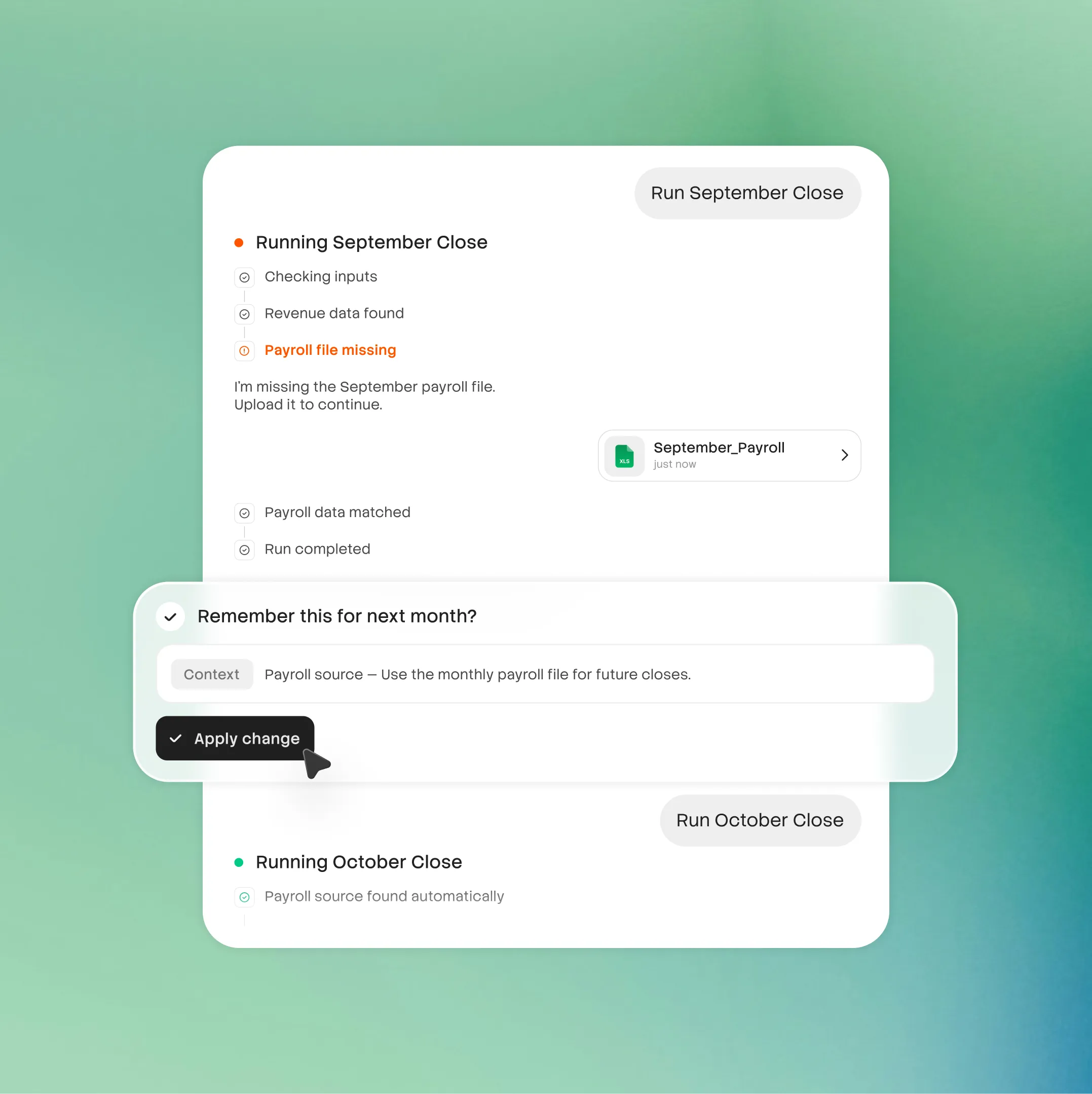
The workflow asks when files are missing. Your corrections get written into the company context so next month is already smoother.
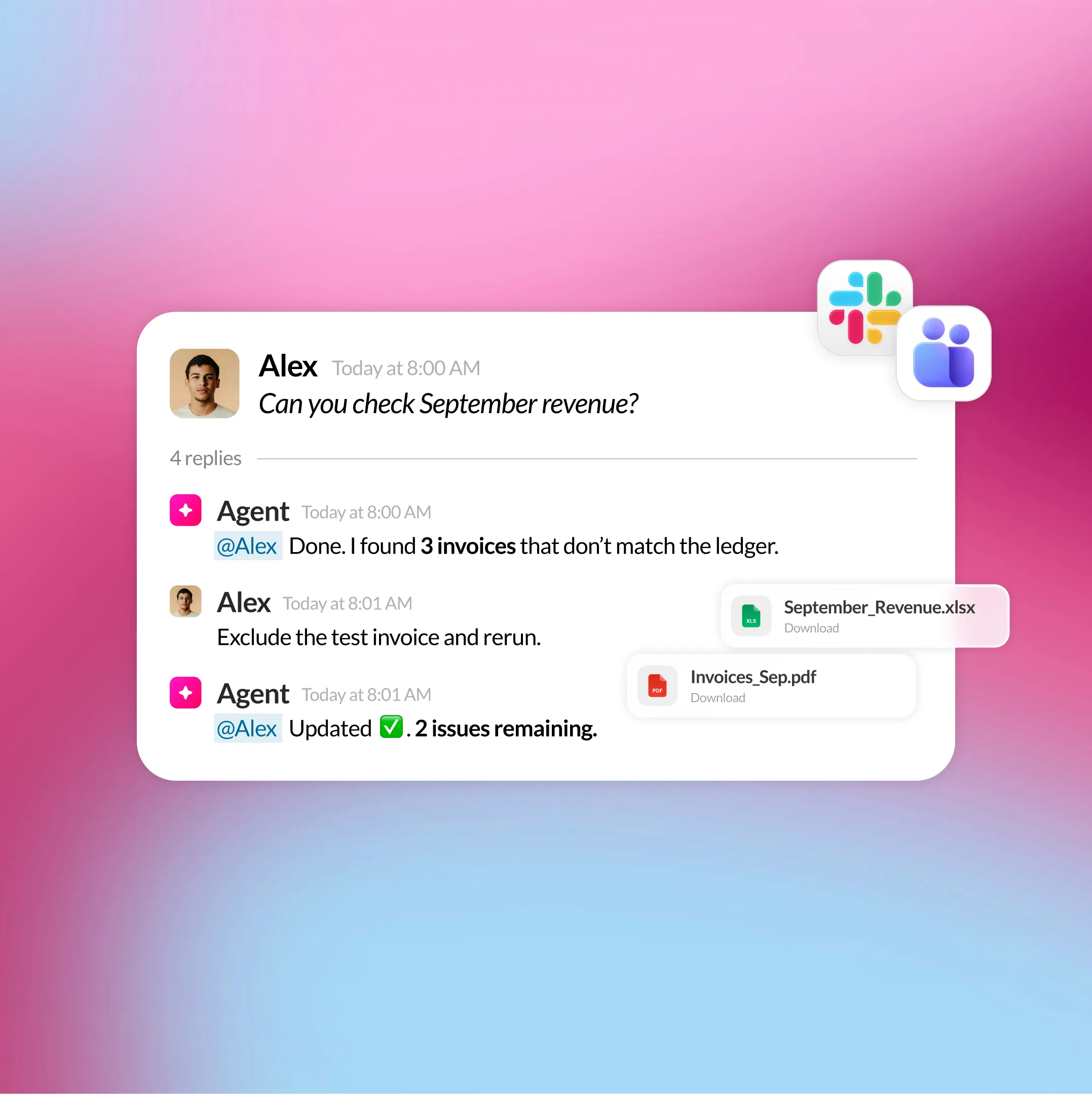
Add an agent to any channel the way you'd add a colleague. Ask, delegate, correct, right in the thread.
With your permission, agents draft the invoice, the journal entry, the payment run in your ERP, billing, or CRM. You approve, it posts. You don't, it doesn't.
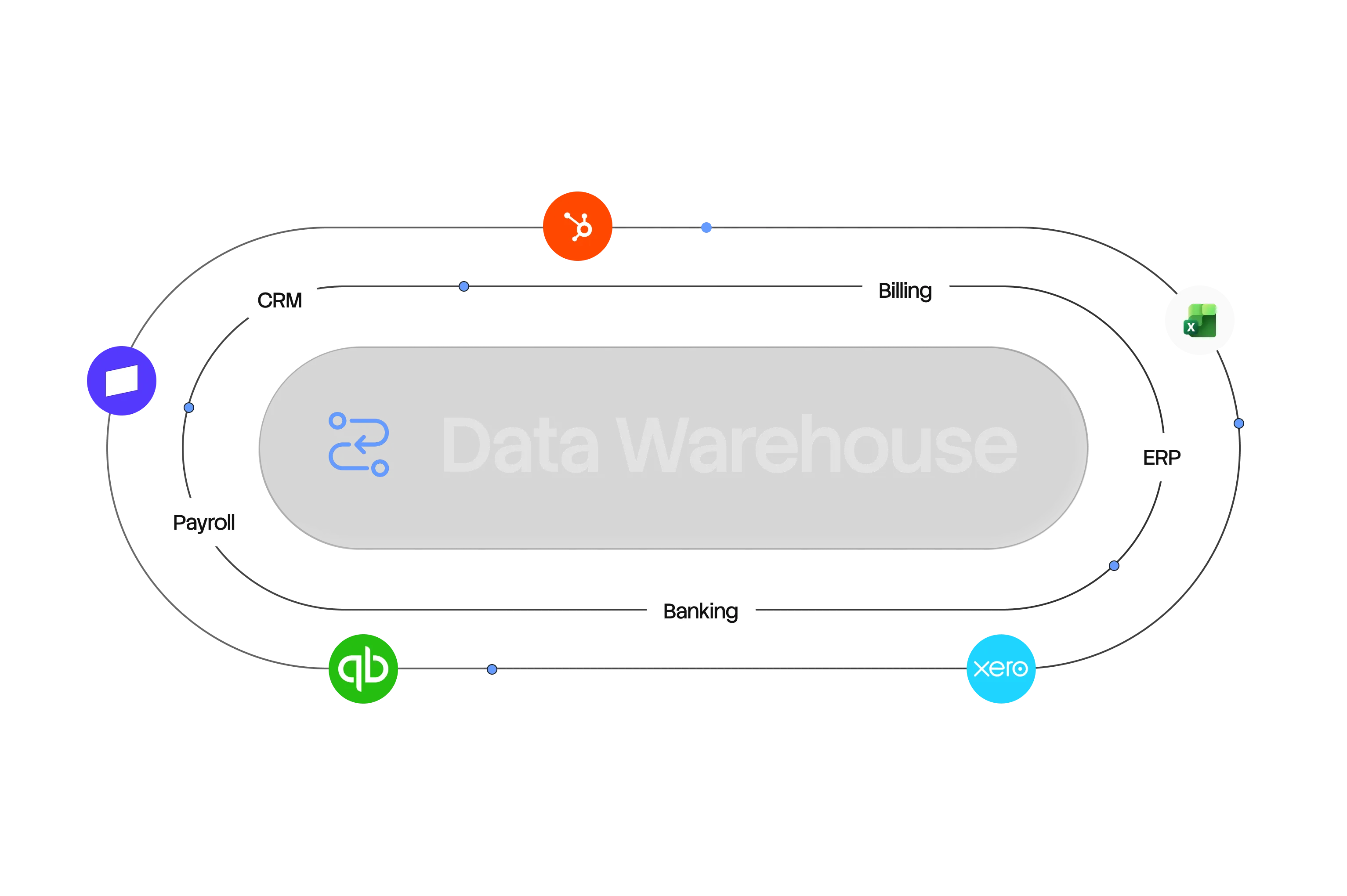
All your sources, normalized in one place before any agent reads them. Two systems disagree on revenue? A rule decides which one wins, once.
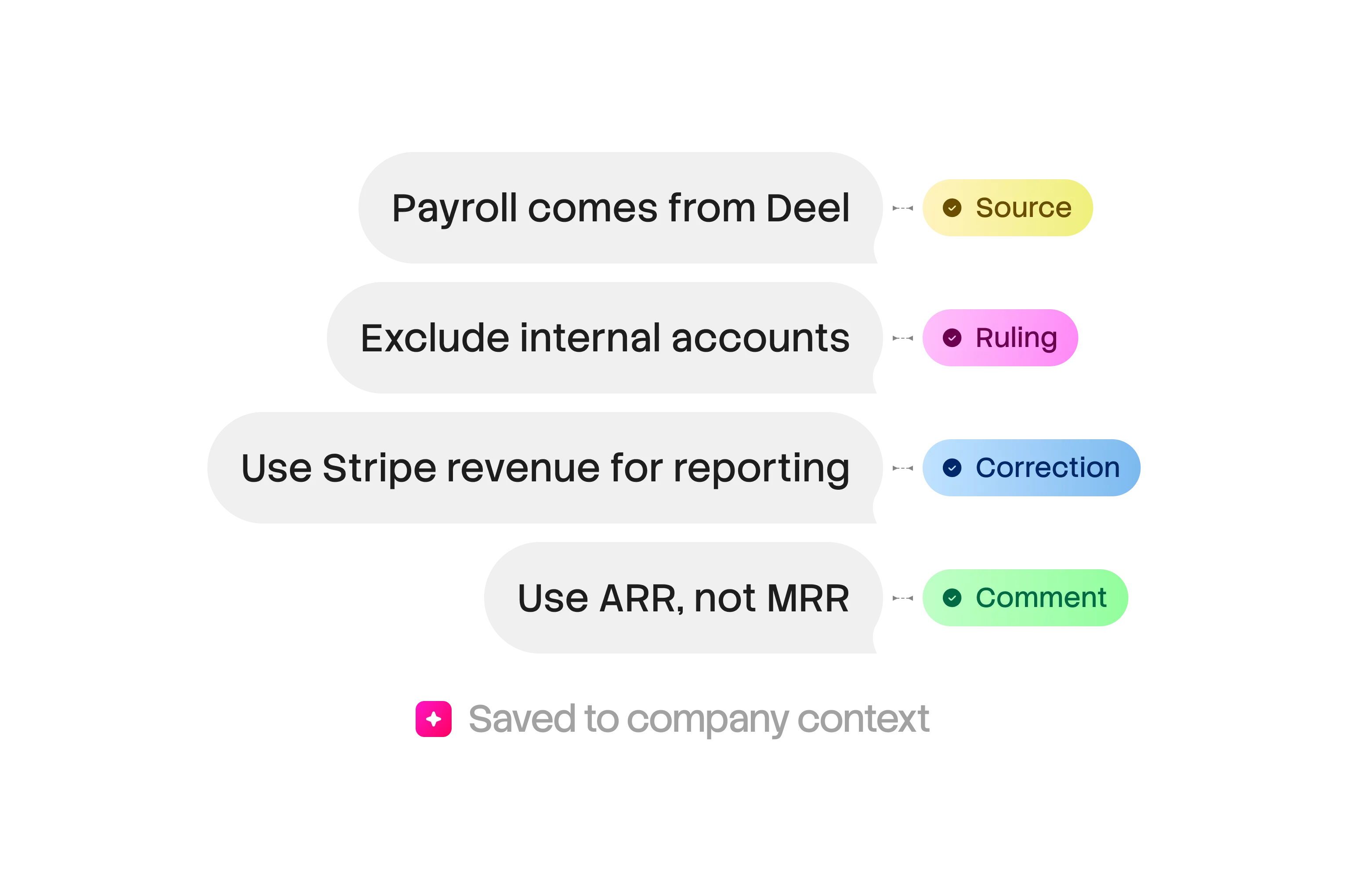
A dedicated agent keeps your context current, and the system remembers every comment, correction, and ruling you make, so it gets smarter with every run.
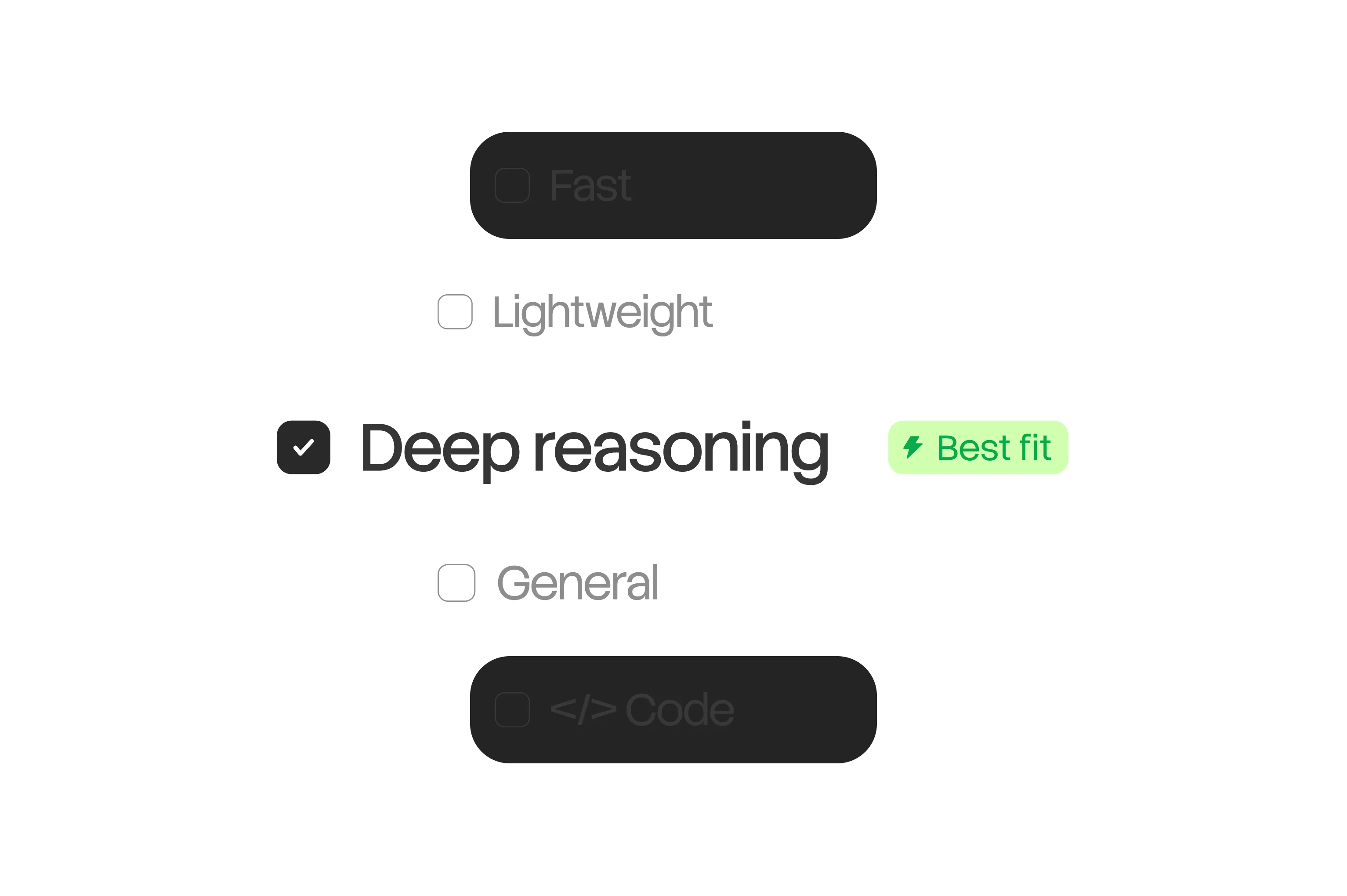
Tokenmaxxing is over. Each agent runs on the right model for its task, and the math runs as code, so workflows cost a fraction of what a general assistant burns.
Every agent is tested on your past periods before you trust it with the current one.
.webp)
Is the data complete? Is every task done? Every run answers both before you see a single number.
.webp)
Every team member gets the access their role needs: who can view, run, edit or approve each workflow.
.webp)
Data used, changes made, assumptions, approver, timestamp. Answerable months later.
.webp)

Pick the workflows that eat the most time and document them as they run today.

Construct the workflow from the agents library, yourself or with a Fuel finance engineer, and run it on previous periods until it matches your signed-off numbers.

It runs on schedule, your team approves at the gates, and the workflow gets smarter every cycle.
Agents run it on your real data for 4 weeks. Customers already reconcile their bank in 10 minutes instead of 2–5 hours a day.
Book a demo

An AI-native finance function is a finance operation where recurring work — reconciliations, close checks, reporting, variance analysis — runs as scheduled multi-agent workflows instead of manual tasks, with humans reviewing exceptions and approving changes. Fuelfinance provides this as a platform: specialized agents chained into workflows that run on your schedule, keep their own business context updated, and report to your team in Slack or Microsoft Teams.
Each Fuelfinance agent performs one specific finance task: matching revenue to invoices, checking that payroll rolls forward correctly, decomposing a P&L, tying out balance sheet accounts. Agents are chained into workflows — for example, a weekly reporting workflow that runs every Monday at 09:00 — and they escalate to your team only when something needs human judgment.
A general AI model connected to QuickBooks sees transactions but has no context: it doesn't know your revenue policy, your chart of accounts logic, or the decisions your team made last quarter. Fuelfinance adds three layers a raw model lacks: a normalized data warehouse where source conflicts are settled once by rules (not improvised by an agent), a persistent memory of every finding and ruling, and governed workflows where nothing posts to your books without human approval.

Yes. Fuelfinance offers a library of 35+ prebuilt finance agents, and you can build custom agents for processes specific to your business — with your team, or working alongside a Fuel finance engineer. Custom agents run on the same platform as prebuilt ones: same scheduling, same memory, same approval controls, same audit log.
Yes. Fuelfinance stores every finding, your ruling on it, and the reason, then reads them back at the next run — a finding dismissed in June doesn't return in July. A dedicated agent also keeps your business context current from each close, call, and Slack thread, so workflows get more accurate with every run instead of working from last quarter's picture of the business.
Yes. Fuelfinance agents live in Slack and Microsoft Teams: your team can ask them questions in a channel, receive scheduled workflow results there, and approve or reject proposed changes without leaving chat. The agents do their work inside your finance systems — ERP, billing, payroll — but nothing is written to those systems until a human approves it.

Every Fuelfinance workflow run is scored twice by the agents themselves: execution completeness (did the agent finish every step of its checklist?) and accuracy (what did it find, and how severe?). Deterministic steps — matching, tying out, recalculating — run as code rather than through an AI model, which removes model error from the calculations entirely. Findings that need judgment go to your team with a confidence score.
No — not without human approval. Fuelfinance agents read your systems but don't write to them: nothing posts to accounting records until a person approves it, and every approval is logged. This read-only-by-default permission model is why finance teams can adopt agents without giving up control of the books.
Yes, if it's built for traceability. In Fuelfinance, every finding points to the transaction rows it came from, every number in a report traces to its source document, and an audit log records what data was used, what changed, what was assumed, who reviewed it, and when — answerable months later for your auditors or board. Nothing is summarized from a summary.

Fuelfinance runs a 4-week proof of concept: 1–2 working workflows delivered on your real data, with measured results — time saved and cycle speed — before you commit. You can build workflows yourself from the agent library or start with a Fuel finance engineer who builds alongside your team.
No. Fuel deploys the system and trains your finance team to run and build agents themselves — the goal is that your team becomes AI-native and creates its own next workflows without engineering support. Picking agents, ordering them into a workflow, and setting a schedule is done in the product, not in code.