See The New Fuel Live Recording


80% of finance executives have either implemented or are actively planning to implement robotic process automation. So if your finance team is still manually pulling reports, copy-pasting transaction data between tabs, and rebuilding the same spreadsheet every month, you're way behind.
Thankfully, intelligent automation in financial services isn't some enterprise-only, six-figure project anymore. It's accessible to anyone and everyone who's tired of wasting another afternoon doing things manually.
This article covers what intelligent automation is, where it makes the biggest difference, and how to get started without losing your mind.
Short version: it's what happens when robotic process automation meets artificial intelligence and machine learning, and the whole thing becomes smarter than the sum of its parts.
Longer version: RPA handles repetitive tasks, like extracting data, filling fields, moving information between systems. Artificial intelligence adds pattern recognition, decision-making, and the ability to handle complex tasks that don't follow a neat script. Machine learning lets the system get better over time without you having to manually update it. Together, those three things form intelligent automation.
So, instead of a person logging into five different tools to compile a report, the system handles data collection, extraction, formatting, and delivery.
Here's where intelligent automation in the financial services industry shines.
You can do better than: export from QuickBooks, paste into a spreadsheet, fix the broken formulas, rebuild the chart, screenshot it into a slide deck, email it around, and wait for someone to reply asking why the numbers don't match last month's version.
Manual data entry is the leading cause of errors in financial reporting. Automating it can give you up to 40% productivity gains.
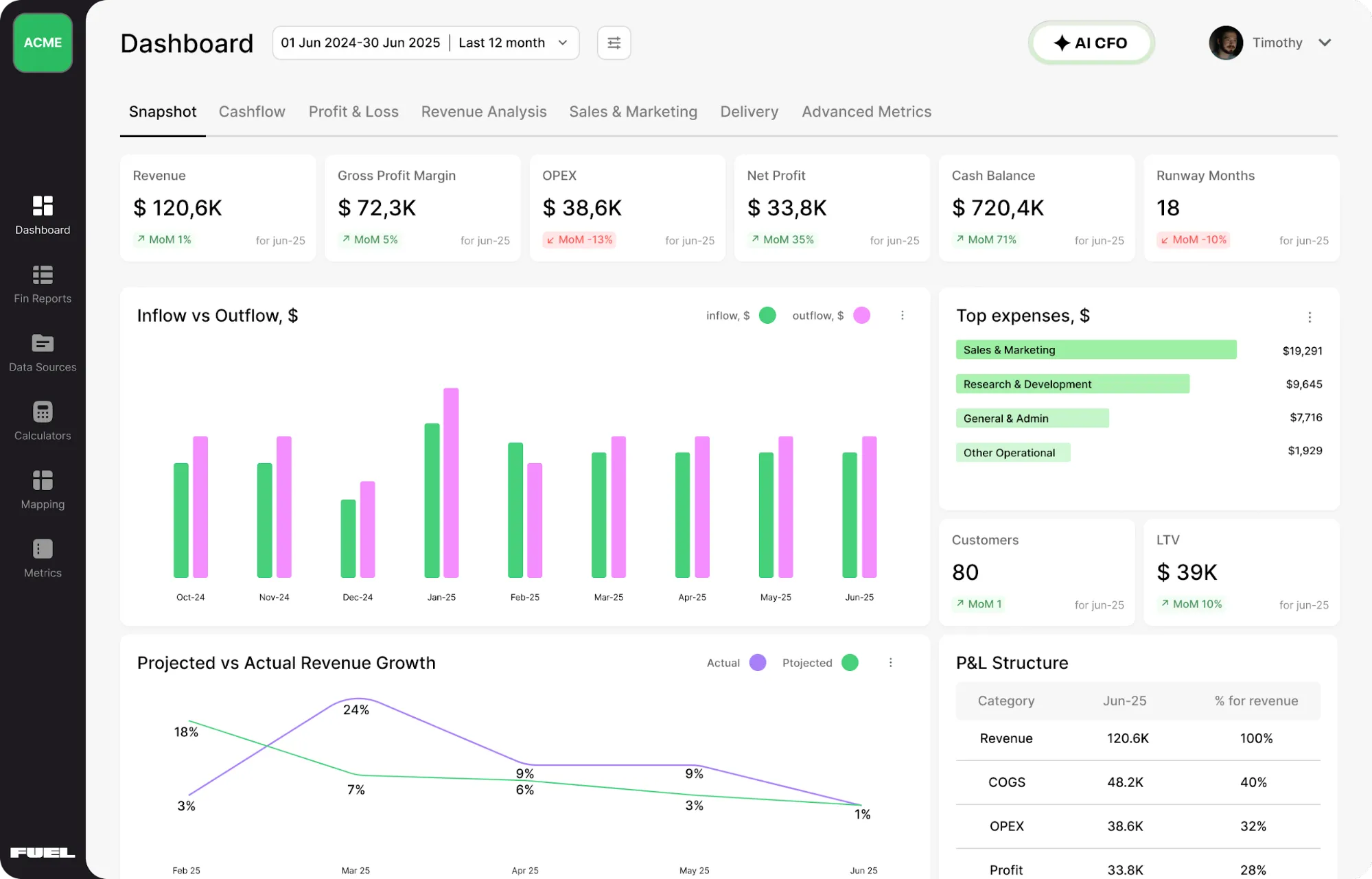
Fuelfinance auto-builds dashboards and pulls live data into your P&L, cash flow, and unit economics views without anyone touching a spreadsheet. Their CFO dashboard updates in real time. You can also use the Google Sheets interface if that's where your team lives; there's no forced context switch.
Standard spreadsheet forecasting is educated guessing with extra steps. You build a model based on what happened before, apply some assumptions, and hope the business roughly follows the line you drew. Then actuals come in, nothing matches.
AI forecasting at Fuelfinance works differently. It analyzes your historical data across all the metrics that matter — revenue, marketing spend, customer acquisition, net profit — identifies patterns you wouldn't catch manually, and generates monthly, quarterly and yearly projections that update automatically. It compares forecast vs. actuals in real time, so you're not discovering a variance at month-end, but when you can still do something about it.
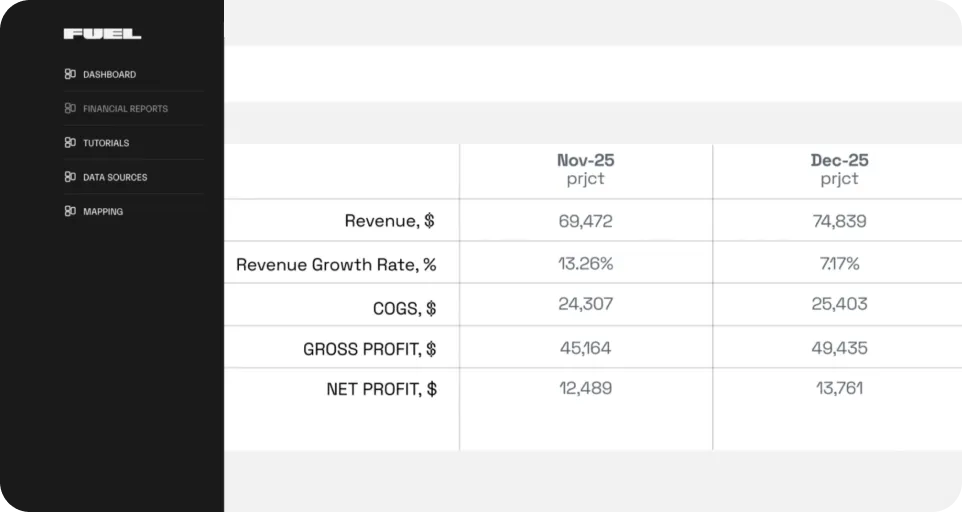
One thing worth clarifying: AI forecasting is a specific capability in Fuelfinance's financial services. Intelligent automation is the broader system that makes it work — the automated workflows, the data pipelines, the integrations. Forecasting is one of the outputs that the system produces.
Fuelfinance's forecasting creates baseline and optimistic projections that live inside your dashboards and update as actuals arrive. Predictive analytics can improve forecast accuracy by 20% — and when you're making a hiring decision or planning a product launch off those numbers, that kind of improvement is the difference between a confident call and a stressful one.
A duplicate invoice gets paid. An expense category quietly goes 40% over budget. A transaction gets miscategorized and sits there until someone notices — usually during a quarterly review, so it can be even six weeks.
Intelligent automation solutions with anomaly detection monitor your transaction data continuously and flag unusual patterns the moment they appear. Unexpected expense spikes, missed payments, budget drift, anything that looks out of range relative to your historical data. It then surfaces alerts and, in some cases, suggests corrective actions. Fuelfinance's AI anomaly detection does this ongoing monitoring automatically, enhancing fraud detection and risk assessment.
Invoice processing and reconciliation are the unglamorous backbone of finance operations. And they're absolutely brutal to do manually at higher volumes. Every transaction needs to be matched, every invoice verified, every discrepancy investigated. When you're processing complex transactions across multiple systems, things fall through the gaps constantly.
Implementing intelligent automation removes the human intervention from the matching process — it reads, categorizes and reconciles transactions automatically, flags discrepancies in real time, and keeps your cash cycle moving. The impact on operational efficiency is huge.
Fuelfinance connects directly to QuickBooks, Salesforce, and over 350 other tools, so accounts receivable and payable stay reconciled without manual data entry. Your existing systems don't need to be replaced. The platform connects to your existing infrastructure and pulls financial transactions, customer interactions and everything else together.
SMBs consistently underestimate compliance overhead until they're staring down a tax audit or trying to produce three years of clean financials for a Series A due diligence process.
Intelligent automation keeps financial records clean, timestamped and audit-ready without ongoing manual work. Compliance checks run automatically. Financial documents are structured and traceable. There's no sprint before the board meeting because everything is already in order.
RPA improves regulatory compliance in financial processes because fewer manual processes means fewer places for errors to hide, plus cleaner records and less exposure. Particularly relevant for financial services organizations operating across multiple jurisdictions or with complex reporting requirements.
Fuelfinance's automated workflows mean your financial reporting services are always current, always structured, and never dependent on someone remembering to update a spreadsheet before a deadline.
No, you don't need a dedicated IT team or to replace your existing systems. Here's what a sensible automation journey looks like.
Before touching any automation tools, map your current financial and business processes. Where is time disappearing? Where do errors show up? Where does everything slow down at month-end?
The usual suspects:
Pick the one that hurts most. Fix that first. The cost savings and reclaimed time from even one automated workflow will make the case for the rest better than any ROI calculator.
A common fear when people start leveraging intelligent automation is that they'll have to overhaul everything. Replace the CRM. Migrate off QuickBooks. Rebuild their reporting setup from scratch. Well, not necessarily.
The best automation solutions work with your existing infrastructure. If you're already using accounting software, a CRM, or a payment processor, you shouldn't need to change any of it. Look for platforms with pre-built integrations, cloud-based access, and fast onboarding. Legacy systems can be a real integration challenge for large financial institutions. At the SMB level, the main thing you need is a platform that speaks to your tools without requiring an engineer to set it up.
Fuelfinance has system integrations to over 350 platforms and is designed to get you from signup to live dashboard in as little as two weeks.
Once your automated workflows are live, you stop being the person who prepares the report and start being the person who makes decisions. Intelligent automation in financial services move finance responsibilities from a reactive, data analytics and assembly function to a proactive one.
Andrew W. Lo, professor and director of the Laboratory for Financial Engineering at MIT Sloan, notes that AI tools can support CFOs in generating quarterly reports and formulating strategic summaries — creating the space to focus on advising the business rather than operating it.
Successful IA implementation means your financial planning and analysis function stops being about managing spreadsheets and starts being about managing the business.
76% of organizations expect a positive impact on business growth from their intelligent automation program within the next two years. Many of those organizations are companies you're competing with. Financial service organizations across the board, from boutique agencies to mid-market SaaS companies, are automating tasks that used to require dedicated headcount, but faster and cheaper.
Automation in financial services ensures the time your team spends on finance is spent on analysis, strategy and decisions, not repetitive processes that software robots can handle at a fraction of the time (and operational cost).
Fuelfinance is a cloud-based platform that combines intelligent automation with a team of actual financial experts — giving you AI forecasting tools, anomaly detection, a real-time dashboard, and intuitive financial management tools without the enterprise overhead. Over 350 integrations. Fast setup. Human support included.
Your finances can be something you actually look forward to checking. See for yourself.
Robotic process automation handles rule-based, repetitive tasks: data extraction, form filling, moving information between systems. It follows a fixed script. Intelligent automation adds AI and machine learning on top, so the system can handle complex tasks, adapt to new patterns, and make judgment calls without human intervention. RPA is the execution. Intelligent automation is the execution plus thinking. Choose automation solutions like Fuelfinance that use both: automated integrations handle your data pipelines, and AI handles forecasting, anomaly detection and financial analysis, for better business outcomes.
For SMBs, the highest-impact areas are financial reporting and dashboards, cash flow forecasting, accounts payable and receivable, budget vs. actuals tracking and compliance readiness. These are the processes that eat the most time, create the most errors, and get the most outdated when handled through manual processes. Fuelfinance covers all of them in one platform connected to your existing systems.
No. And anyone selling it that way is oversimplifying. Intelligent automation solutions perform tasks like data assembly, manual data entry and repetitive processes, so your team can focus on the data analysis and decisions that actually require a human. Your CFO, finance manager or FP&A lead still bring the strategic context no software can replicate. With Fuelfinance, you also get access to dedicated financial experts alongside the platform — automation and human intelligence working together, not one replacing the other.
In FP&A, intelligent automation takes over the data work — pulling actuals, updating forecasts, tracking plan vs. actual, flagging variances — so your team can focus on interpreting the numbers rather than assembling them. Fuelfinance's AI forecasting builds baseline and optimistic projections, updates them automatically as actuals come in, and surfaces everything in dashboards your whole team can use. Faster financial analysis, sharper decisions, no end-of-month scrambles.


Just imagine how that would transform your team’s productivity and focus? Talk to our financial experts to know more.