By Alyona Mysko, Founder & CEO of Fuel · In partnership with CFO Connect
Every week, a finance leader tells us some version of the same thing: “We know agents are coming. We just don’t know what they’d actually do here.”
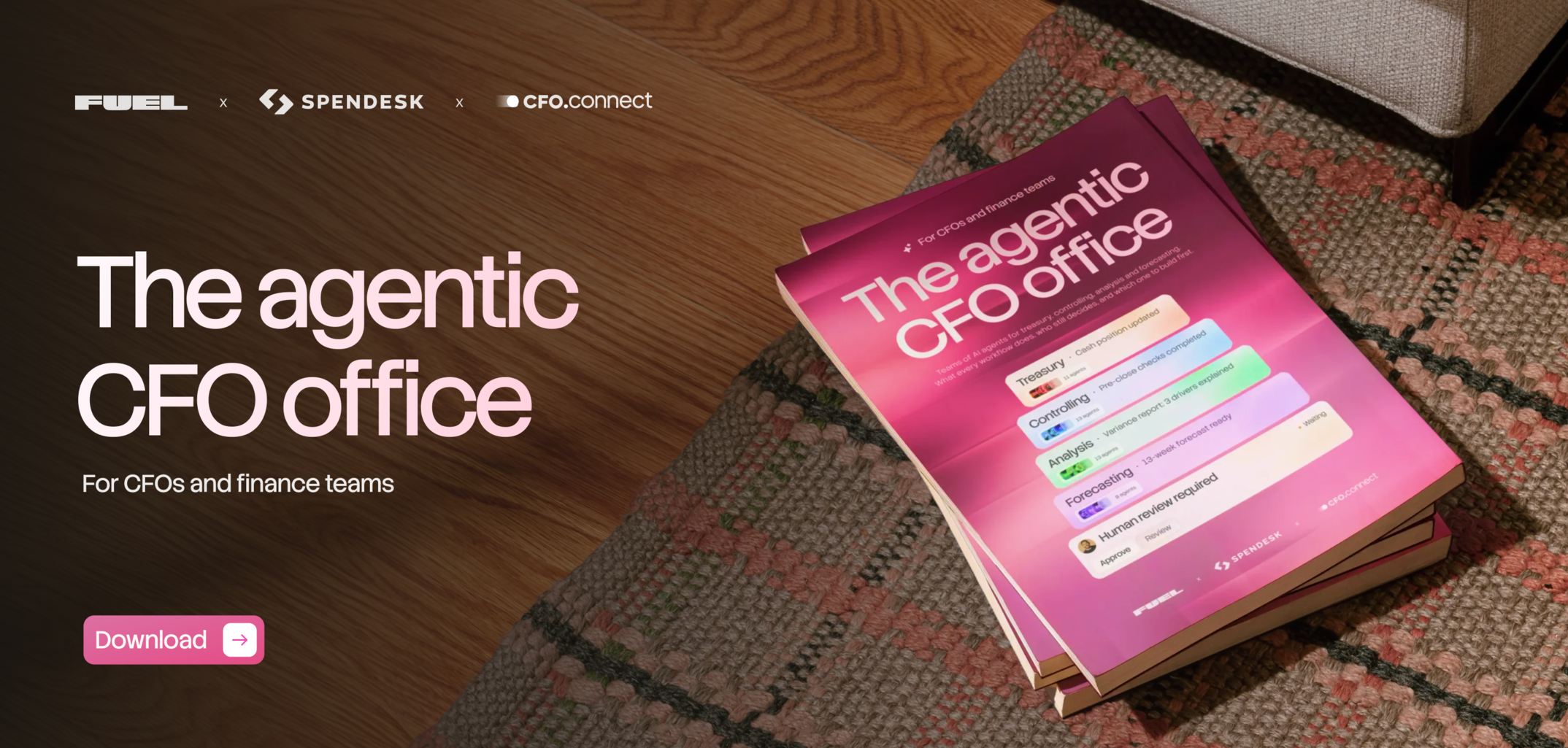
This free guide is our answer. We mapped every AI agent in the CFO office, team by team: treasury, controlling, analysis and forecasting. You’ll see what the agents take on, what your people still decide, and which workflow to hand over first.
Written for CFOs, heads of finance, controllers, FP&A leads and treasury leads.
It’s a team of AI agents doing your recurring finance work. Each agent takes one small task, like matching, reconciling, checking, drafting or chasing, and hands the result to the next. Your finance team keeps its structure and its people. They still review, decide and sign.
We call this the agentic CFO office. It’s not autonomous finance. There’s a person at every checkpoint, and nothing touches your books until someone approves it.
It starts with context: your business logic and finance rules, written down once and shared by every agent. You already have most of it. It’s in your Excel models, your Notion pages, your ERP and your process owners’ heads.
Each agent does one small job. A remittance reader, for example, opens the customer’s email, reads the PDF, pulls the invoice lines and works out who paid.
Chain a few agents together and you get a workflow, which runs a finance process from start to finish. Build an agent once, and you can reuse it in every workflow that needs the same task. Workflows connect too. Plan vs actual explains every forecast miss, and that becomes the starting point for the rolling forecast.
We mapped every finance process we’ve seen run on agents, and grouped them by the team that owns them.
Treasury starts every day with the same questions: what came in, what went out, what’s still open, and where do we stand? Agents reconcile the bank accounts overnight. By morning, the CFO has a cash report with a likely cause next to every open item, and your cash manager only looks at what doesn’t match.
Before and during the close, agents check every transaction, not a sample. Your controller gets a short list of findings, each linked to the rows behind it, and makes the call on every one before the close moves ahead.
Agents break every P&L change into drivers, trace each variance back to the transactions, and draft the commentary. Your analysts stop building the deck and start explaining what the numbers mean.
Agents keep the cash forecast current every day, and ping you in Slack if cash drops below your floor. They rebuild the rolling forecast in three scenarios and log every assumption that changed. Your team decides which scenario to believe.
Start where the rules are clear and the data lives in one place. For most teams, that’s daily cash position, invoice to cash or variance analysis. Run one until your team trusts it, then add the next. Leave the month-end close and the rolling forecast for later. They have the most handoffs, and every owner is involved.
The guide places all 16 workflows on an impact and effort map, based on our customer rollouts. Download now.