See The New Fuel Live Recording


Your revenue lives in three systems. Your rev rec lives in the gaps.
Here's a close I've watched happen at more $10M+ companies than I'd like to admit: the contract gets signed in DocuSign. Sales celebrates, Slack emoji, done.
Chargebee creates the subscription, mostly matching the contract. Mostly. Someone typed the ramp schedule in by hand, and the start date is off by a billing cycle. QuickBooks receives the invoices and knows nothing about either of them.
And then, on day one of close, a finance person opens all three systems side by side and starts matching. Contract to subscription. Subscription to invoice. Invoice to GL. Line by line, deal by deal, every single month.
Nobody planned this job, nobody hired for it. It just accumulated — one integration gap at a time — until reconciliation quietly became the biggest line item in your close.
Here's the part that should bother you more than the lost week:
Every manual handoff is 2 problems wearing one trench coat. It's a delay, and that's the visible cost, the close that slips to day 12. It's also an error surface, with every re-key, every eyeballed match, every "I'll fix that mapping later" becoming a place where the contract says one thing and the GL says another. These errors are what your auditor finds.
Because when the deferred revenue waterfall doesn't tie, the gap traces back to exactly these seams: the DocuSign amendment that never made it into Chargebee, the credit memo that hit QuickBooks but not the schedule. Your revenue is correct in every individual system and wrong in between.
The two jobs of revenue recognition (and why one layer can't do both)
At $10M ARR, rev rec is really two jobs. Companies keep buying one tool and expecting it to do both.
Job one is a systems problem: keep your contract terms, your billing events, and your GL in continuous agreement. Not reconciled once a month by a heroic human — in agreement, all the time, so that "does the schedule match the contract?" is a question the pipeline answers before you ask it.
Job two is a judgment problem: decide how to treat the deals that don't fit the pattern — and be able to defend that decision later, to someone whose job is to doubt you. As customer contracts grow more sophisticated, revenue recognition becomes less about processing transactions and more about applying consistent accounting judgment. The pipeline can surface the exception but it cannot make the accounting decision.
Job one: a pipeline, not a process
A process is something your team does. A pipeline is something your systems do. Most companies at $10M ARR have a very good process in place (even if it’s documented, checklisted, and fast) sitting where a pipeline should be.
Here's what changes when that flips.The contract-to-subscription match stops existing. DocuSign contracts map to Chargebee subscriptions automatically, not just “faster”. Nobody does a faster version of a job that isn't there.
The export-and-VLOOKUP layer goes with it. Billing reconciles into QuickBooks continuously. There is no more need for a CSV, a recon_v3_FINAL tab, or gaps for a spreadsheet to fill. The worst thing is, deferred revenue gaps surface when they open, not when the auditor ties out the waterfall.
How do you know it's time to focus on this problem and find a continuous solution, not a quick fix that will only keep you through the month?
If:
The goal isn't faster manual matching, but no manual matching at all.
That's job one: bought, not built, solved this quarter. Which frees your team for job two — the one no pipeline can do.
Job two: the deals your pipeline flags but can't decide
The pipeline just freed your team from matching. Here's what it handed them instead.
Because at $10M ARR, a slice of your deals won't fit any pattern — and these are exactly the ones your best logos sign:
The multi-year enterprise deals with ramped pricing and a termination clause. Does that clause change the contract term — and with it, the whole revenue timeline? That's a call, not a computation.
The mid-term expansion. Modification or new contract? Two defensible answers, two different revenue numbers.
The usage commitment with rollover credits. Nobody priced that deal with ASC 606 in mind. Now someone has to decide what a rollover credit even is under the standard.
The partnership deal with a revenue share. Gross or net? The answer can move revenue by the size of the whole deal.
In every case the pipeline flags the anomaly. In no case does it pick the answer. Notice the pattern: detection is automatic, decision is not. The pipeline surfaces the exception. It can't take the position for you.
By this stage, finance already knows that something unusual happened. The question is how that transaction should be treated under ASC 606, the accounting standard that governs when and how companies recognize revenue from customer contracts, and whether that conclusion has been documented to the next controller, the next year audit or the finance team two years from now. Documenting the accounting position turns a one-off judgment into a repeatable precedent for every similar deal that follows.
ASC 606 guidance intentionally relies on professional judgment because no two customer contracts are exactly alike. It provides a framework but finance and accounting teams are still responsible for applying that framework consistently and documenting the rationale behind the decision.
Your auditor doesn't ask what you did. They ask why.
This is where documentation becomes just as important as automation. The strongest finance teams treat documentation as institutional knowledge, not an audit deliverable. Every accounting position should capture the relevant facts, reference the applicable guidance, document the rationale behind the conclusion and link back to the supporting source material. Purpose-built AI-native tools like Quillon can currently streamline the research and documentation process creating an auditable record that compounds in value with every complex accounting decision.
The result is fewer hours spent recreating historical analyses, less back-and-forth during audit, faster responses to PBC requests and greater consistency as new contracts are evaluated against prior accounting positions. Audit discussions shift from gathering evidence to reviewing conclusions and institutional knowledge stays with the company instead of walking out the door with employee turnover.
The stack, assembled
.webp)
Put the two jobs side by side and the stack draws itself. Start with where your revenue already lives: DocuSign → Chargebee → QuickBooks.
Three good systems, and three versions of the truth, and your team becomes the reconciliation layer, one matched line at a time. Fuel replaces that layer, becomes a pipeline keeping the three you have in agreement:
→ Contract signs in DocuSign → maps to its Chargebee subscription automatically. Kills: the manual match, and the mistyped ramp that haunts the schedule for years.
→ Chargebee bills → reconciled into QuickBooks continuously. Kills: the CSV-export-and-VLOOKUP layer, and every error that lived in it.
→ Schedules and deferred revenue → monitored as they roll forward, gaps flagged the month they open. Kills: the eleven-month-old discrepancy your auditor finds in February.
Standard deals flow straight through this lane to close. And the non-standard ones? The pipeline doesn't guess. It flags them and routes them out of the automated lane, to the desk where a human takes the position.
That's where the second half of the stack begins.
Most finance stacks stop at the general ledger. In practice, that is often where the most complex work begins. Once an exception is identified, finance needs a repeatable workflow for researching the applicable guidance, evaluating prior accounting positions, preparing journal entries and calculations and documenting the accounting conclusion.
Exception Detected → Technical Accounting Research → Accounting Memo →
Revenue Recognized → Period End Close & Audit
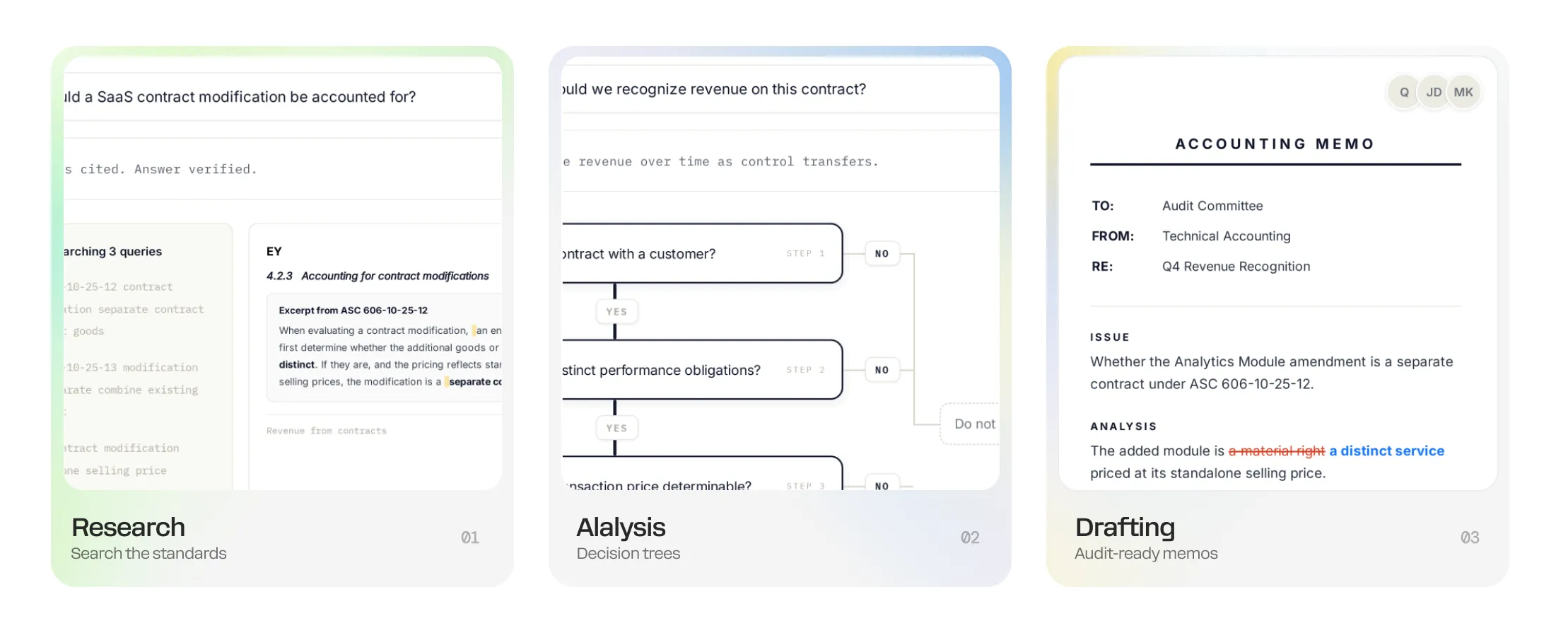
The resulting accounting position provides the basis for recording the appropriate journal entries and recognizing revenue in the general ledger or ERP system. Every step remains connected, allowing reviewers to trace the final accounting treatment back to the underlying guidance, supporting evidence, calculations and management's documented rationale - completing a fully traceable workflow from contract to the general ledger, period-end close and ultimately the financial statements.
Together, these two layers transform revenue recognition from a reconciliation exercise into a connected and repeatable operating model that scales with the business. Every accounting judgment can be understood, reviewed and applied consistently - regardless of complexity. That's the difference between simply closing the books and building a finance function that scales. The modern revenue recognition stack isn't defined by the systems it connects. It's defined by the confidence it creates.
What to fix this quarter
1. Time your last close. Not the whole thing — just the matching. How many hours went to confirming that DocuSign, Chargebee, and QuickBooks agree with each other? That number is your reconciliation tax, and here's the uncomfortable part: every one of those hours produced zero new information. Nothing was learned. Three systems were simply caught up to each other, by hand, again. Whatever that number is, it's the cost of running a process where a pipeline should be — and now you know exactly what fixing it is worth.
2. Pull your deferred revenue waterfall and run the archaeology test. Go line by line and ask one question: who could defend this number to an auditor today, without excavating old exports and Slack threads? Every line that fails is a gap that's already open — you just haven't been asked about it yet. The lines that fail for mechanical reasons (the amendment that never reached the schedule) are the pipeline's job. The lines that fail because nobody wrote down the reasoning? That's your list for step three.
3. Write one-page positions for your top three non-standard deal patterns — before audit season, not during. Start with the transactions that require the most judgment. The goal isn't to document every contract. It's to document the decisions that are likely to be made again. Build a library of accounting positions gradually. You don't need fifty memos on day one. A handful of well-supported positions covering your most common complex revenue transactions will make every close and audit more efficient, while creating a stronger foundation for future accounting decisions.
If reconciliation is eating your close, Fuel is the pipeline layer: DocuSign, Chargebee, and QuickBooks in continuous agreement, stood up in minutes. If your accounting positions live in Slack threads, Quillon is the judgment layer, then research, memos, and full traceability from conclusion back to the standard.
Start with whichever job is failing louder. Just don't ship another close pretending there's only one.


Just imagine how that would transform your team’s productivity and focus? Talk to our financial experts to know more.