
New Free Guide: Claude for CFOs & Finance Team → Get it now


You checked the numbers last week. Cash flow looked fine. The forecast said you were on track. Then time went by — a client paid 30 days late, two invoices hit at once, a deal that was "definitely closing this week" didn't — and suddenly the picture looks nothing like the spreadsheet you were staring at.
It's not that you're bad at finances. The problem is that traditional financial forecasting was never able to handle the speed, complexity or unpredictability of real, dynamic business growth. What can catch up with that pace is AI financial forecasting. Let us explain.
AI financial forecasting involves using machine learning, natural language processing and other AI solutions to analyze historical data, identify patterns in your financial performance, and generate predictions that update automatically as new data flows in — continuously.
Traditional methods work like this: someone on the finance team spends hours (days, sometimes) in a spreadsheet — pulling unstructured data from disconnected sources, building formulas, making assumptions about market conditions and growth rates. The output is a forecast that was reasonably accurate on the day it was built. A week later, less so. A month later, it's fiction.
AI-powered forecasting doesn't have an expiration date. It connects to your actual financial data sources (accounting software, bank feeds, CRMs, payment processors) and runs a continuous analysis of your transaction history, invoice patterns and cash flow movements. The predictive models recalibrate as the business moves, improving forecast accuracy.
There are three main areas where the gap between traditional forecasting and AI tools in financial forecasting is most clearly visible:
With most planning and forecasting processes at growing companies, by the time the financial data has been collected, cleaned, formatted and shared, the business has already moved on. New invoices arrived. A subscription churned. A vendor payment landed earlier than expected.
Financial professionals still spend nearly 40% of their time on manual, automatable tasks, with spreadsheets persisting as the dominant planning tool despite sophisticated alternatives at hand's reach. That's almost half of skilled labor going into maintaining numbers that are going stale in real time. It means your most important financial decisions are being made on information that's already behind.
Human analysts of market trends and financial data are good at many things. Error-free formula management across a 47-tab spreadsheet model is not one of them. 94% of business spreadsheets used in decision-making contain errors.
One mislinked cell, flipped sign or row excluded from a SUM, and your forecast is confidently, cheerfully wrong. Human error is a built-in feature of manual financial modeling, with real consequences for strategic decision-making.
If your business has more than one revenue stream (let's say: subscription and one-time, products and services, multiple customer segments with different payment terms) your spreadsheet is simplifying things in ways that undermine the whole financial forecasting process. Traditional methods force you to round off the edges until the model is manageable.
One survey found that 92% of CFOs say forecasting accurately is a challenge — and 46% call it a significant challenge. These are finance leaders whose entire job is planning. If they're struggling with accurate forecasts, no wonder you are.
A spreadsheet can't handle expense management across multiple business units, marketing spend split across six channels with different lag times, variable payroll, seasonal revenue, or subscription churn that affects next quarter more than this one. AI can.
Here's how AI tools' advanced capabilities help make more accurate plans:
Traditional forecasting typically gives you one number — your "expected" outcome, which you build your plans around. That's fine until reality diverges from expected, which it reliably does.
AI-driven forecasting at Fuelfinance generates multiple scenarios simultaneously: a baseline reflecting current trends, an optimistic scenario that tells you how to act when you come across growth opportunities, and a conservative scenario to help you prepare for the worst case. More accurate predictions across all three let you plan ahead successfully. Short-term forecasts in the 0–30-day window typically land within ±5–10% of actuals. Medium-term forecasts across 1–3 months usually come in at ±10–15%.
Here's how AI financial forecasting supports strategic planning with deeper insights and business intelligence.
AI-powered revenue forecasting breaks down why revenue is moving and what’s likely to happen next.
Instead of relying on simple trend lines, AI models analyze historical performance across product lines, pricing tiers, customer segments and payment behavior simultaneously. This allows them to detect subtle patterns, such as early signals of demand shifts, delayed revenue recognition due to payment cycles, or underperformance in specific segments that might otherwise be hidden.
More importantly, AI identifies key indicators of revenue change, like pipeline velocity, conversion rates or changes in deal size, so teams can act before the impact shows up in financial statements.
The result: finance and sales leaders understand the drivers behind the forecast and where to intervene to hit targets.
Rather than simply tracking historical spend, AI budget forecasting continuously monitors expense patterns across categories, vendors and time periods. It flags anomalies, like gradual cost creep, irregular spikes or inefficient spend allocation that traditional budgeting processes may miss.
This is especially valuable for businesses with volatile cost structures (e.g., agencies, construction, e-commerce). AI can model how expenses are likely to evolve based on operational drivers such as project load, hiring plans or supplier pricing trends.
This lets finance teams move beyond static budgets toward dynamic forecasting, where spending expectations are continuously updated and aligned with real business activity.
The outcome: fewer surprises, tighter cost control, and the ability to course-correct before small inefficiencies become material problems.
Instead of optimizing for surface-level KPIs (like clicks or leads), AI models track how changes in spend across channels influence downstream metrics such as customer acquisition cost (CAC), conversion rates, deal velocity and ultimately revenue.
It can simulate scenarios and forecast how those decisions will impact pipeline quality and future revenue. AI helps identify diminishing returns and channel saturation, so teams stop over-investing in what isn’t financially efficient.
The result: marketing and finance operate from the same data, enabling smarter budget allocation based on real ROI, not intuition or vanity metrics.
AI models can detect early warning signs of churn by analyzing behavioral, transactional, and engagement data, such as reduced usage, delayed payments, friction in support or changes in customer interaction patterns.
Teams get a forward-looking view of customer risk, creating a window to intervene with targeted actions, like outreach, pricing adjustments or product support.
AI can also segment customers by lifetime value and churn probability, helping teams prioritize retention efforts with the greatest financial impact.
The outcome: more predictable recurring revenue, improved customer lifetime value and a measurable reduction in avoidable churn.
Fuelfinance is a cloud-based financial management platform built for growth-stage companies — combining proprietary AI software with a dedicated human financial manager, so you get more accurate forecasts and someone who actually helps you act on them.
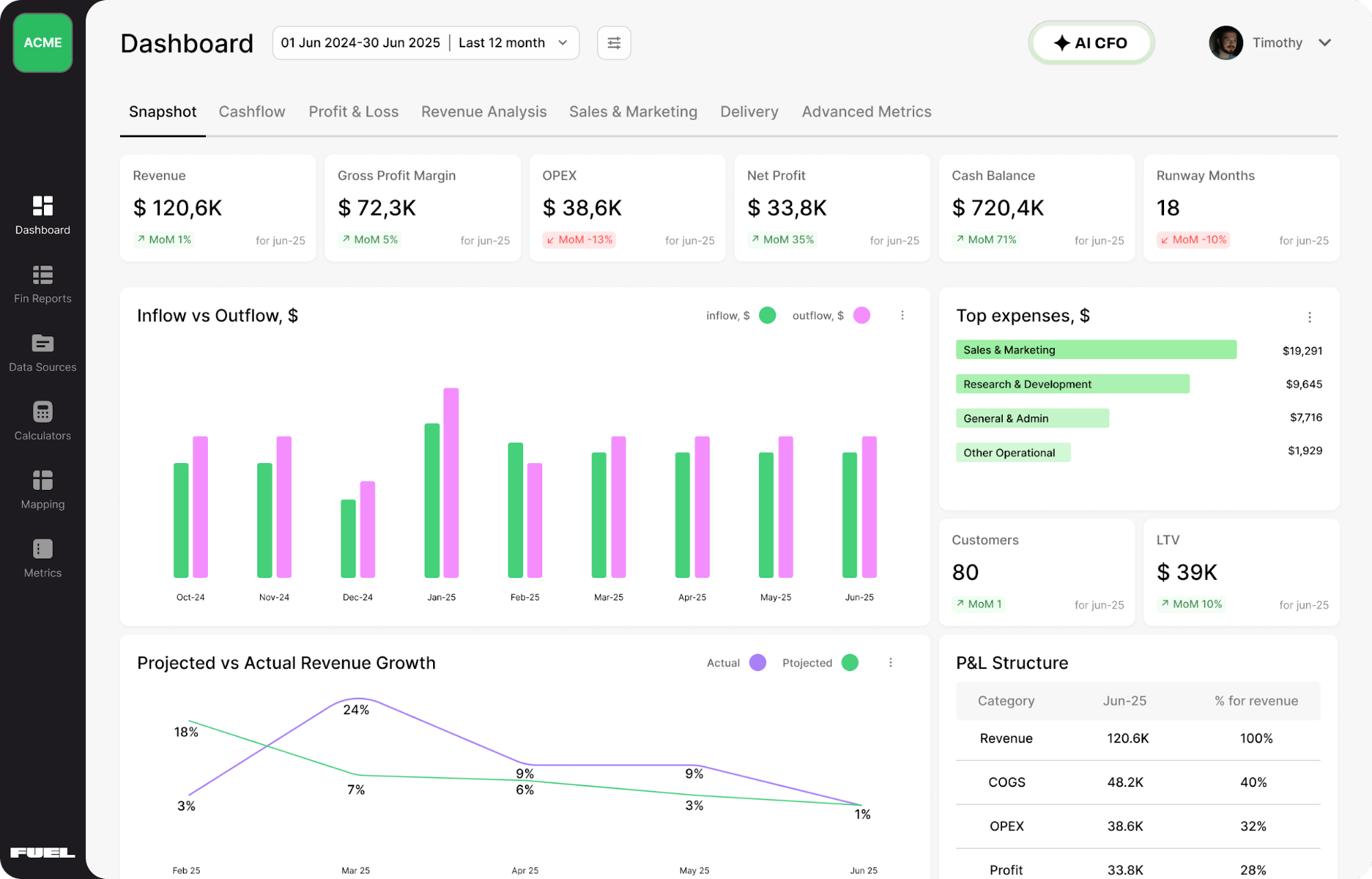
Here's what the platform delivers:
For finance leaders evaluating AI finance tools, the combination of AI forecasting capabilities with genuine human support is what separates Fuelfinance from platforms that leave you alone with a dashboard and a user guide.
AI financial forecasting doesn't eliminate uncertainty — nothing does. But it does shrink the gap between your financial projections and your actual financial results, always letting you know where you stand, and giving you the extra time to respond before a pattern becomes a crisis.
Fuelfinance takes that capability and makes it accessible to growing businesses without the enterprise price tag or the lengthy implementation. Your financial planning should work as hard as you do. Our deep learning tool does this automatically, continuously and with more accurate financial forecasts than a spreadsheet can ever provide.
Accuracy depends on data quality and your planning horizon. With Fuelfinance, short-term forecasts (0–30 days) typically land within ±5–10% of actuals. Medium-term forecasts (1–3 months) generally come in at ±10–15%. Forecast accuracy improves over time as the AI models learn more of your historical data and business patterns. One of our clients' plan vs. actual deviation dropped from 50% to under 10% after implementing proper AI driven forecasting.
With Fuelfinance, onboarding is measured in days, not months. The platform connects to your existing accounting software, banking feeds, financial institutions you use and business tools via 350+ integrations. Once connected, the AI begins analyzing historical data and building forecasts immediately — it's not a complex data science project.
Fuelfinance's AI works from your full transaction history, invoices, payment timelines, cash flow records, and data from connected tools like QuickBooks, Stripe or HubSpot. The system handles a significant amount of data cleaning automatically, which addresses one of the most common concerns around data quality when businesses first explore AI in financial forecasting. More historical data produces more accurate financial forecasts. The system still generates useful predictions early on, but compounds in accuracy over time.
Fuelfinance's anomaly detection feature builds a baseline model of your normal financial patterns — what your expense rhythm typically looks like, what revenue fluctuations are within your normal range, what payment timing usually resembles across your customer base. When new financial data deviates from those patterns, the system flags it. That might be an unexpected cost spike, a revenue trend that's breaking from its historical pattern, or payment behavior that suggests a cash flow risk is building. You get the alert when there's still time to act, not when the damage is already reflected in your numbers.


Just imagine how that would transform your team’s productivity and focus? Talk to our financial experts to know more.


.png)