Meet Fuel MCP: talk to Claude about any financial decision


As a founder, understanding pre-money and post-money valuation is crucial, especially for attracting early-stage investing.
These metrics help you determine the worth of your company before and after receiving investments, impacting ownership percentages and investor relations.
Understanding these concepts empowers you to make informed decisions, negotiate better deals and attract the right investors.
But how do you determine your company's value? Do you have to hire outside experts to estimate it?
Not at all.
You can do it yourself with our free valuation calculator, following this guide.
But before we explain how to do it, let’s first break down pre- vs post-money valuation in simple terms to give you a solid foundation for what's coming next.
You probably see these expressions everywhere but have yet to figure out what they actually mean. Let us explain it in simple terms and with some examples to illustrate.
The pre-money valuation shows a company's estimated value before it receives any outside funding. Think of it as a starting point showing where the company currently stands.
Several factors determine the pre-money valuation, including its assets, intellectual property, brand strength and market opportunity.
While it primarily reflects the company's present state, it also considers future potential. Projections of future revenues play a significant role in shaping this valuation, offering a preview of what the business could achieve.
Negotiations between founders and potential investors also influence the final pre-money valuation.
On the other hand, after completing an investment round, the post-money valuation shows the company's updated value, including the new capital funding. This metric allows you to gain insight into how the company grows and how attractive it remains to investors.
Simply put, it gives a clear view of the company's financial health after receiving investment, providing both founders and investors with an understanding of its new position on the market.
Post-money valuation is excellent for determining existing shareholders' ownership stake in the company. It also influences the business's ability to raise future funds.
What investors really want from early-stage startup finances is a higher post-money valuation that makes the company more appealing and results in more favorable terms for the company.
Armed with a clear understanding of their post-money valuation, founders can make more strategic decisions, whether planning expansions or considering mergers and acquisitions.
Calculating the difference between pre-money and post-money valuation is essential because of the following:
Here's how to do your company's pre-money valuation in only five steps.
In order to calculate pre-money value, it's necessary to get to know the basics of this process. Don't worry – you don't need to be a financial expert or browse through tons of resources online. We've already done that for you.
The first step would be to read this article and get familiar with it before you start.
As you'll learn, it's essential to consider not just your revenue growth but also how your profits and margins are doing.
You don’t need to do the math manually; we've prepared a free pre-money valuation calculator. Download it now and come back once you’re done – we’ll walk you through filling it in.
FORM FOR GETTING A CALCULATOR
For accurate valuation, prepare both your current financial data and your estimates for the next five years, especially in terms of revenue, contribution margins and operating expenses.
Now that you have the calculator and your financial data handy, all that’s left for you to do is enter your information.
When evaluating your business, consider both hardware and software components if your revenue comes from both. If you only work with one, just fill in the data relevant to that part.
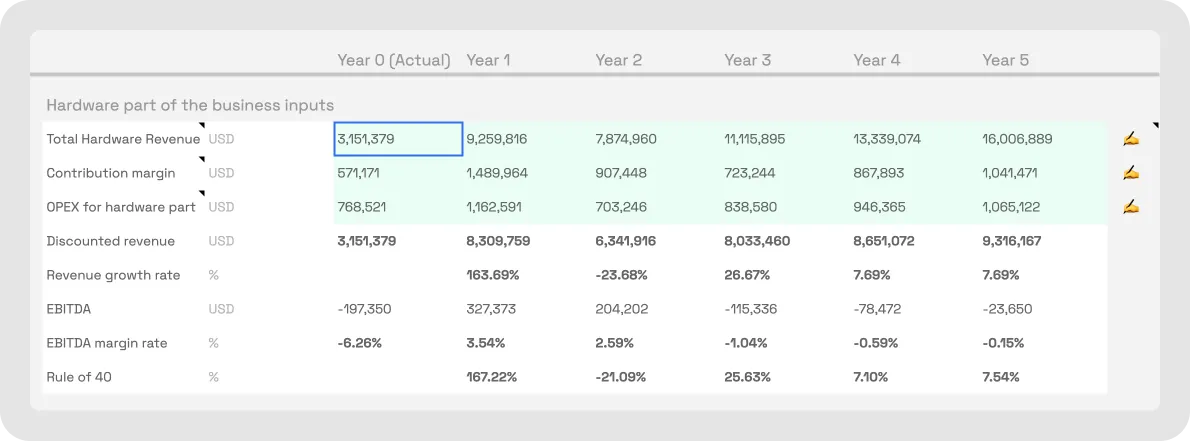
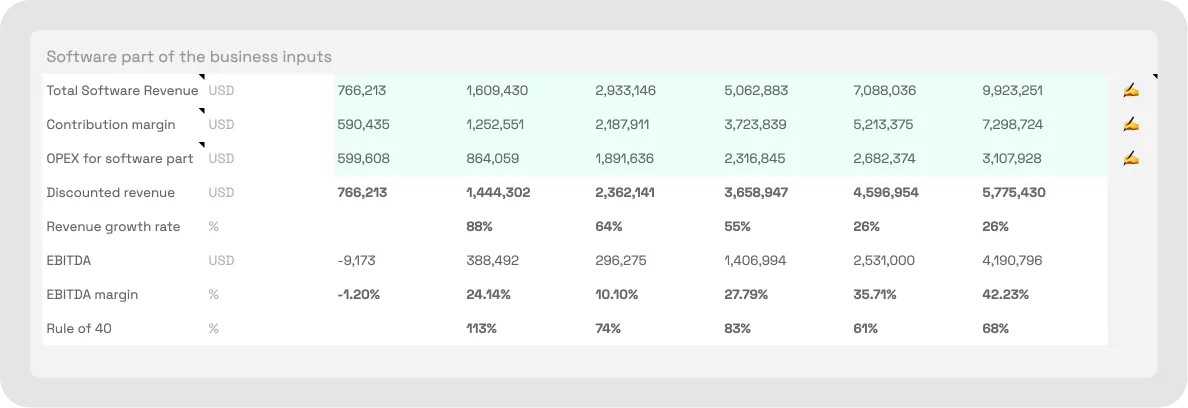
In both software and hardware parts of the business inputs (see the screenshots above), the light green color shows where you should enter your data manually.
All white fields are automatic calculations based on your input. You don't have to add anything there.
P.S. If you don't understand some terms, simply hover over a particular field, such as the rule of 40. We've left short explanations to help you out.
Finally, update market ratios. They’re tailored to your business model and industry.
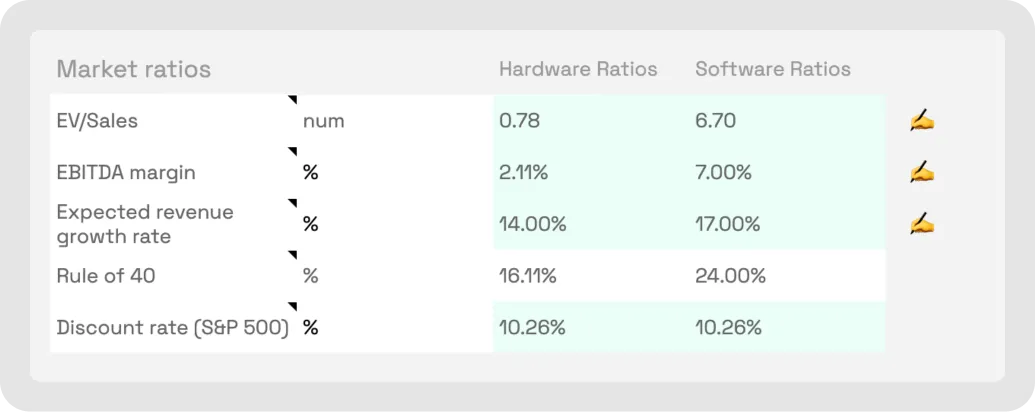
The same principle applies here as above. You only have to fill out the green fields. Pay attention to your startup's financial model and make sure your data is up to date.
In the Company Valuation Template, we've included links to ratios for your specific situation. They help you find information about:

Finally, this is what your end result should look like:
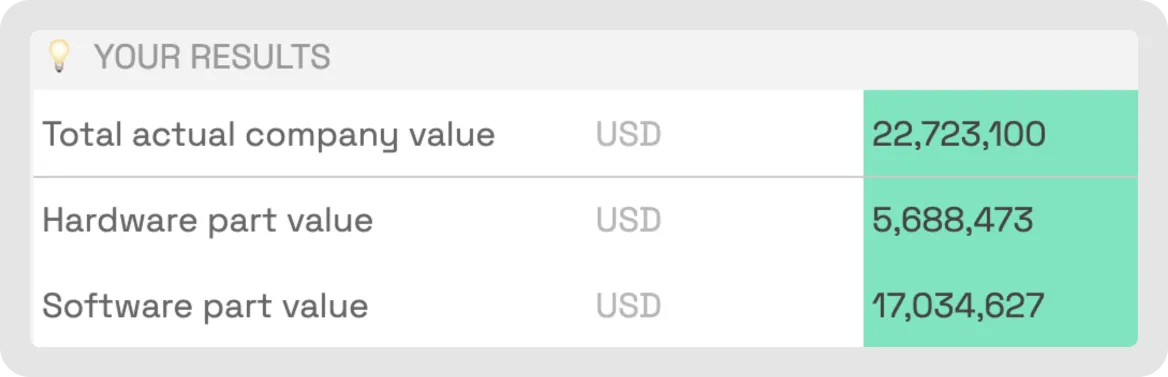
The values in the green fields are automatic calculations based on the data you inputted in the market ratio and hardware and software charts.
The question of how to calculate post-money valuation shouldn't scare you, either.
Use this simple formula to calculate your post-money valuation:

The post-money valuation is a sum of the pre-money valuation and investments or the amount of money an investor is ready to pay for a property or asset.
However, suppose we don't know how much the company was worth before receiving funding, but we do know how much money was raised and what percentage of the company was given to investors. In that case, we can calculate its post-money valuation after receiving the funding using a specific formula:

Calculating pre- and post-money valuation doesn't have to be daunting, especially if you're using our valuation calculator.
But that's not the only thing we can do for you.
At Fuelfinance, we provide specialized financial management solutions tailored for companies at any phase, along with ongoing support from our team of financial experts who serve as your outsourced CFO.
Here are some more features of our financial analysis software:
Starting a business comes with its challenges, and at Fuelfinance, we get that. That's why we created a simple financial management tool for SMBs and founders. Even if you're not a finance expert, our solution makes it effortless to manage your money.
Fuelfinance isn't just about balancing your books – it's your go-to tool for everything from understanding how much your business is worth before and after funding (pre- and post-money valuations) to revenue recognition and figuring out how long your money will last (calculating runway).
Plus, with Fuelfinance, you'll get ongoing support from our team of experts who are there to help you with all your financial questions and needs.
Ready to see how Fuelfinance can simplify your finances?
Book a demo today and let us show you how easy it can be to automate your financial management.
Pre-money valuation refers to the estimated value of a company before receiving any external funding. On the other hand, post-money valuation considers investment funds showing the company's updated value after receiving an investment. Valuation on a pre-money basis helps company founders understand the value of their startup and negotiate better deals with investors. Valuation on a post-money basis helps investors understand how their investment transforms in equity value and what they'll actually get.
There are different pre-money valuation methods, but let's say you use the Comparable Company Analysis (CCA) method to compare your company with similar businesses in your industry with known valuations. For example, you may find out that similar companies are valued at five times their annual revenue. Now, calculate your yearly revenue. Let's say it's $1 million. In that case, your pre-money valuation would be $1 million * 5 = $5 million. Of course, this is largely simplified, as you should also consider any differences in size, growth rate, market and other relevant factors.
Ownership percentages in a company are calculated based on post-money valuation. It shows each investor their exact ownership percentage based on their invested amount. However, you'll still need a pre-money calculation, as it calculates a company's post-money value.
SAFE stands for Simple Agreement for Future Equity, a valuation method investors often use to convert their investment into future equity. A pre-money SAFE valuation is the company's valuation before considering the SAFE investment. A post-money SAFE valuation is the company's valuation after the SAFE investment. The difference between the two shows investors how much of the company they will own once their SAFE investment converts into the company's equity.


Just imagine how that would transform your team’s productivity and focus? Talk to our financial experts to know more.





.png)